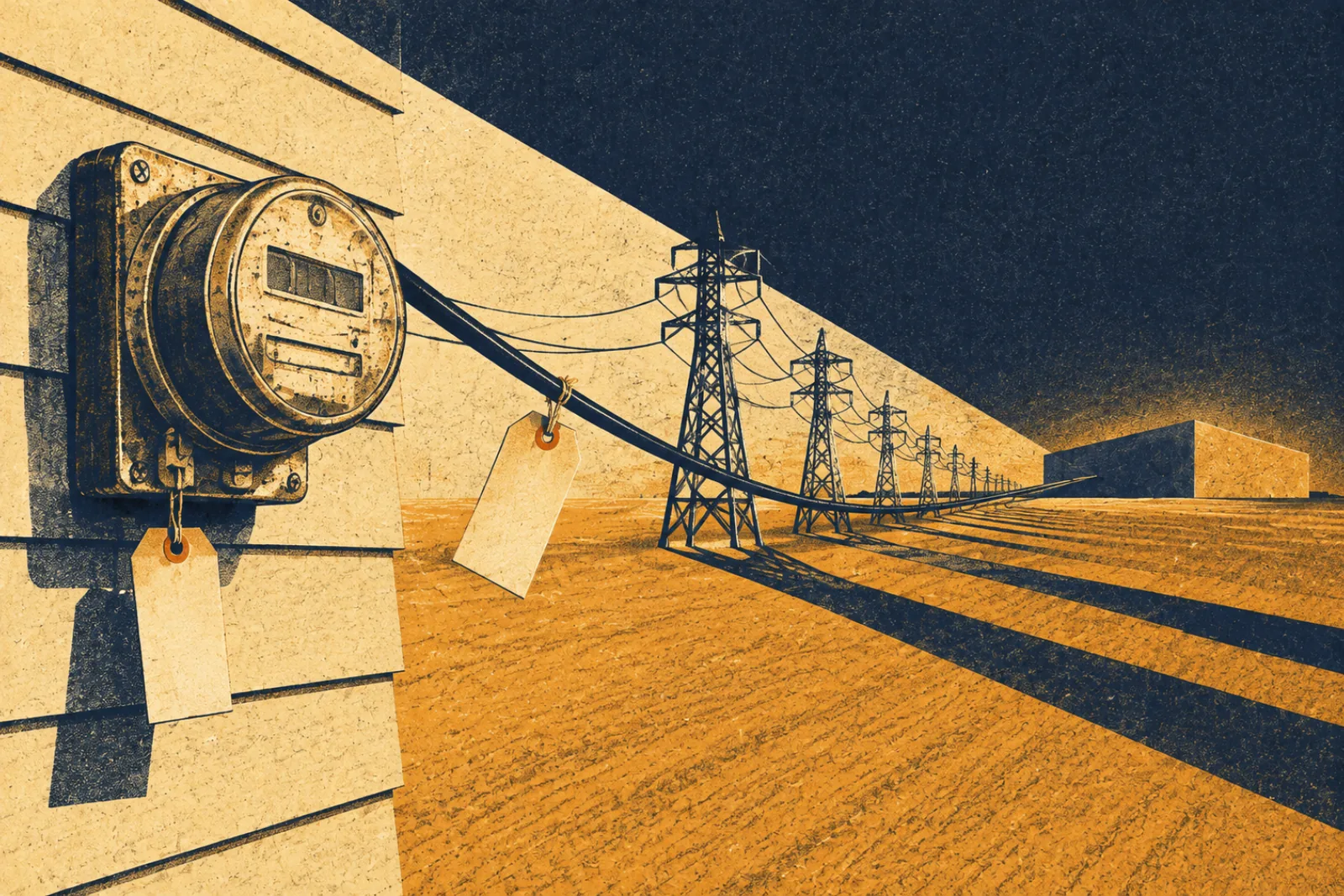
Start with Virginia. In November 2025 the State Corporation Commission created a rate class for Dominion's largest customers, GS-5, and set its terms in a final order (case PUR-2025-00058): a customer in the class pays minimums of 85% on distribution and transmission and 60% on generation, for 14 years. Maryland followed in May with the Utility RELIEF Act, which lowered the large-load threshold to 25 MW; BGE, Pepco and Delmarva Power, the state's three Exelon utilities, filed revised large-load tariffs on Sept. 1 and 2 in the commission's PC72 proceeding. New Jersey's Data Center Fair Share Act, law since July 7, assigns large data centers all the costs attributable to them. Pennsylvania issued a model tariff in May that binds no one.
The companies moved the same way. Microsoft published its community-first commitments in January, and in March the White House announced a Ratepayer Protection Pledge. Constellation said on its Nov. 9 call that it had signed three more long-term agreements since the prior quarter, about 4,560 MW, and its earnings release says more than 1,000 MW of new generation will come "with no costs being borne by existing customers." NRG told investors in August that it had structured the first project in which the hyperscaler brings its own generation; its third-quarter release says the 1.2 GW project remains on track, and on its Nov. 9 call it said it expects to announce it, in Texas, by year-end.
Read in a row, these look like the bill leaving the household. They move one bill of two.
Where the new rules stop
The first bill is the wire: the substation, the line, the upgrade a campus needs to connect. The states and the pledges mostly address that bill. Where they reach generation, as Virginia's 60% minimum does and as the White House pledge does by asking signers to "build, bring, or buy" new supply, they assign the large load its share without lowering the auction's clearing price. The second is the auction. PJM buys capacity for every customer on its grid and charges the cost to the companies that serve load, which pass it into the tariff. The last three auctions cleared at the cap, by PJM's reports for 2026/2027, 2027/2028 and 2028/2029. The most recent cleared at $325.00 a megawatt-day, 6,831.3 MW short of the reliability requirement, with a reserve margin of 14.4% against a 20% target, for a total of about $16.4 billion for one delivery year, a figure PJM says is not the cost to load, since hedged load is not exposed to it. For 2029/2030 the cap rises to $337.83, by PJM's planning parameters, on a peak forecast 3.6% above the last one.
No GS-5 minimum and no voluntary pledge changes that price. PJM's load forecast puts additional large loads at 33,707 MW in 2030, about 18% of a 183,008 MW peak, and PJM does not split the shortfall into new load and retiring plants, so how much of the cap-clearing the new load caused is unresolved.
The gap shows in PJM's own backstop. In July its board decided who pays for emergency procurement if the auction falls short: the cost goes to the zones by their new load and, if the utility does not pass it to that new load, to all load in the zone. Where a state has no rule for new data centers, the board wrote, it is not clear to whom the cost will be assigned. FERC, in a June order, told PJM to show why its tariff is just and reasonable without provisions against shifting costs onto other transmission customers, or to fix it, and left shifting at the retail level to the states.
The sharpest exchange on the auction bill is about supply. Paul Gerke, on his Factor This policy podcast of Oct. 8, cited a PJM shortfall of more than 6.8 gigawatts as soon as 2028, close to the 2028/2029 auction's 6,831.3 MW, and said more generation must come online as soon as possible. Stephen Lacey, on Latitude Media's Open Circuit on Oct. 20, said the push to draw more from the existing grid through distributed resources and flexibility had arguably gained more momentum in a few months than in the prior decade. Lacey's point narrows Gerke's rather than refuting it. For the household the difference is the price: flexibility that clears below the cap shrinks the auction bill without changing who pays it.
The household's bill is already rising. Residential prices in August rose 11.3% from a year earlier in Virginia, 10.4% in Ohio and 9.2% in Pennsylvania, against 3.4% nationally, by DeepStack's arithmetic on the EIA's Electric Power Monthly. New Jersey was flat. One month carries weather and fuel, and the EIA does not isolate the auction. Politics moved too: in Georgia, outside PJM, Democrats won both Public Service Commission seats on the Nov. 3 ballot, by the unofficial count.
The case that scarcity pays the owner
One side holds that new load enriches whoever owns firm power and the grid, and that while the cap holds, the auction bill lands on everyone. Torsten Slok of Apollo wrote on Oct. 21 that energized land and grid access "are the scarcest input and hardest to replicate." Jigar Shah, on Volts in April, gave the utility version: load growth spreads fixed costs over more kilowatt-hours, which "allows you to lower electricity bills for everybody." That holds for the wire when the new customer pays its share, not at an auction where new demand against short supply sets everyone's price. On Open Circuit in July, which he co-hosts, Shah turned the point on data centers that leave the grid: they add no kilowatt-hours to the shared bill and tighten the supply of equipment, and he told them, "Everything is going up in price because of you."
The generators said where the money landed. Constellation, Vistra and NRG credited part of their second-quarter gains to higher PJM capacity prices; Vistra's third-quarter release cites higher realized capacity prices, and on its Nov. 6 call it tied the year's rise to larger PJM capacity payments.
The case that the bill changes hands
The other side holds that policy is already pulling the bill off the household. Ryan McEntush of a16z, writing about Texas on Oct. 7, gave the planner's motive: planners "don't want ratepayers covering upgrades built for projects that never show up." Oregon, outside PJM, shows what such a law can do: after its POWER Act, the governor's office says, PGE's residential rate fell 1.3% and the data-center rate rose 29%.
On this view the cap does the rest. PJM's board sought to extend its price collar through 2029/2030, and FERC approved it; Talen, on its Nov. 3 call, reported rumors of another cap for the spring auction. A lower cap, or new supply that clears the auction below it, is how the generator gives up rent.
Can the hyperscaler carry it?
The disagreements DeepStack kept turn first on whether the hyperscaler can absorb what the states hand it. Ren wrote on Nov. 4 that it can: a couple of points of return lost to higher power costs is a rounding error against $720 billion to $740 billion of combined capital spending, and the real exposure is delay. Mia Silverio of Prof G Markets disagreed on Nov. 9, arguing that delay may help the hyperscalers rather than hurt them, which hold 48% of global data center capacity, because what they already own becomes worth more. Gaetano read Google the other way on Nov. 4: short of its own capacity, it rents compute, and that margin drag could last. Steve Eisman, on Nov. 6, said a political slowdown, which he called a big if, would land hard on suppliers from GE Vernova to the neoclouds.
Ren drew his own limit. At the $43.8 million per megawatt economics he modeled, policy costs shave a few points and are survivable; at about $15 million, closer to older contracts, a project already earns about 8% against a cost of capital near 10%, and added fees start to decide which projects get built. Gaetano, on Nov. 8, pointed to Florida's commission, which, he wrote, on Nov. 3 rejected Duke Energy Florida's large-load tariffs for failing to show that each qualifying customer would pay its full cost of service. Minimum bills alone do not settle who pays, which is the question before Maryland's commission.
Around the queue
The second fault line is whether the hyperscaler can step off the shared grid. Michael Spencer of AI Supremacy counted on Oct. 27 roughly 140 major U.S. projects, about 16 GW slated for 2026, with only about 5 GW under active construction and the rest stuck in utility studies and power queues. Shayle Kann, on Latitude Media's Catalyst on Oct. 22, answered that onsite gas is often the fastest route to firm power at scale, with tens of gigawatts coming in the next couple of years. Eisman's Oct. 30 hedge sits in the middle: if the power constraint is real, construction could slow next year.
Doomberg named the limit on that exit on Nov. 4. Gas turbines are sold out for years, with some orders placed today not filled until 2030 and some 2032 delivery slots already taken. JunkBondInvestor added on Nov. 9 that both escape routes, a friendlier state or generation behind the meter, are narrowing: Pennsylvania pulled data centers from its fast-track permitting in August, and Texas's permit halt reaches behind-the-meter generation. Bringing your own power is the cleanest way out of the shared bill. The turbine order book decides how many can take it.
The vote
The third fault line is the midterms. Spencer read the results on Nov. 5 as a wave that will extend moratoriums and delay many data centers. Kakashii answered on Nov. 6 that the buildout began under a Democratic administration and is here to stay, and that hyperscalers are already agreeing to handle their own power and water. Tae Kim, the same day, expected Texas to keep building after a few months of new deals with its governor-elect. Doomberg's turbines cut against both: politics may cost months, equipment years.
What the cap is worth to the generator
The generator gives up rent only if the cap comes down, so DeepStack ran one rough ruler on that rent. Take the swing from the 2029/2030 cap of $337.83 a megawatt-day to $290, apply it to each generator's cleared megawatts for a year, and set the result against the midpoint of its 2027 adjusted EBITDA guidance. The swing comes to 2.4% for Vistra, whose 2027 guidance runs from $7.7 billion to $8.5 billion, and 6.6% for Talen, whose midpoint is $2.675 billion.
Read it with four caveats. The $290 is DeepStack's own low-side value, not a level PJM or any company has anchored. The numerator is the 2029/2030 delivery year and the denominator is 2027. Vistra's cleared megawatts come from POWER magazine's report, not from Vistra's release; Talen's come from its own release. And it measures single companies, not every generator in PJM. Whether the swing is material is open.
DeepStack's view
DeepStack's Call is that there are two bills. The connection bill is moving to the hyperscaler where states have written rules, and in contracts and pledges; Florida shows it can stall. The auction bill stays with the household through Dec. 22, because nothing the states or the companies have done changes the clearing price, and PJM's board wrote that where a state has no rule it is unclear who bears the backstop's cost. The generator gives up rent only if the cap is lowered or new supply clears below it, and Talen reported only rumors of another cap. Conviction: 3 of 5.
The next test is the auction itself. DeepStack expects the 2029/2030 RTO price at $290 a megawatt-day or more, after three auctions at the cap, shortfalls in the last two and a higher peak forecast; the step sits $47.83 under the cap. Dec. 22 tests the price; who carries it is set by the state rules and the backstop's allocation, which is why Maryland's order is the Part's other test. Three things would change the view: an auction below $290; backstop results that assign most of the cost to large loads by state rule; or a new, lower cap for 2030/2031.
The power plant that must be there when the load arrives is still on everyone's bill.
The hyperscaler is starting to pay for the wire to its door. The power plant that must be there when the load arrives is still on everyone's bill. On Dec. 22, PJM says how much.
The numbers
The bill in PJM's states
Change in the average residential price of electricity, August 2026 against August 2025, percent; New Jersey is the PJM state that stayed flat
- Virginia+11.3%
- Ohio+10.4%
- Pennsylvania+9.2%
- United States+3.4%
- New Jersey−0.4%
Source: U.S. Energy Information Administration, Electric Power Monthly, Table 5.6.A, October 23, 2026; changes are DeepStack arithmetic. One month carries weather and fuel, and the EIA does not separate the capacity auction's share.
The DeepStack Call
Two bills: the household keeps one
DeepStack's view is that there are two bills with two payers. The connection bill is moving to the hyperscaler where states have written rules, and in contracts and pledges. The auction bill stays with the household through Dec. 22: nothing the states or the companies have done changes the clearing price, and PJM's board wrote that where a state has no rule it is unclear who bears the backstop's cost. The generator gives up rent only if the cap comes down or new supply clears below it. How much that rent matters is open: 2.4% to 6.6% of 2027 EBITDA guidance at Vistra and Talen, by DeepStack's arithmetic with four caveats.
The strongest published case against
Stephen Lacey · Oct 20, 2026: Momentum behind leveraging DERs and flexibility technology to get more out of the existing grid has arguably been greater in the last few months than in the prior decade, as policymakers from Texas to Virginia to Washington to California respond to…
Answers Paul Gerke · qualifies
What to watch
The dated tests this Part set
- Dec 22, 2026PJM's 2029/2030 capacity auction: does the RTO price reach $290 per megawatt-day or more?pendingQuestion →
- Dec 22, 2026The same auction: does the RTO price clear below the $337.83 cap, after three auctions at the cap?pendingQuestion →
- Feb 22, 2027The EIA's full-year 2026 rates: does PJM's median residential rise run four points above the other 42 jurisdictions', with Texas below the U.S.?pendingQuestion →
- Mar 31, 2027Maryland's commission: an order approving a BGE, Pepco or Delmarva large-load tariff that bills transmission or PJM capacity costs to that class?pendingQuestion →
29 sources cited
- Utility RELIEF Act - Hb1532
- PC72 proceeding - Pc72
- Data Center Fair Share Act - 32 .HTM
- model tariff - Puc releases final order establishing first of its kind large load model tariff framework 05132026
- community-first commitments - Community first ai infrastructure
- Ratepayer Protection Pledge - Ratepayer protection pledge
- earnings release - Ceg 20261109991
- third-quarter release - Nrgq32026ex991
- 2026/2027 - 2026 2027 bra report
- 2027/2028 - 2027 2028 bra report
- 2028/2029 - 2028 2029 bra results report
- planning parameters - 2029 2030 planning period parameters for base residual auction report
- load forecast - 2026 load report
- wrote - 20260727 cifp reliability backstop procurement pjm board decision
- June order - 20260618 el26 67 000
- on his Factor This policy podcast of Oct. 8 - Factor This: PJM's energy emergency | Factor This Policycast…
- Electric Power Monthly - Epm table grapher.php
- unofficial count - 11032026GeneralAndSpecialElection
- wrote on Oct. 21 - Winners and Losers if the Data Center Buildout Is Delayed
- on Volts in April - Volts: Doing data centers the not-dumb way (2026-04-15), part 1
- third-quarter release - Vistra 20260930xearningsre
- writing about Texas on Oct. 7 - Why Texas Is Making Data Centers Wait
- governor's office - Oregons power act delivers lower rates for oregon families and businesses higher costs for data…
- extended - 20260212 board decision on price collar for 2028 2029 and 2029 2030 capacity auctions
- went further on Nov. 9 - Is the AI Trade the Biggest Loser of the Midterms?
- counted on Oct. 27 - Anthropic S-1 & Datacenters are Politically Unsustainable in 2026
- named the limit on that exit on Nov. 4 - Recycle Bin
- added on Nov. 9 - Credit Weekly: Who Funds the Delay?
- Spencer read the results on Nov. 5 - Is Recursive Self-Improvement the Moat of Anthropic?
Text, numbers, Call and tests from the DeepStack engine, data as of Nov 23, 2026. Analysis and opinion, not investment advice.