The week, in our words
The equity cushion is almost gone. The 10-year Treasury yields 5.24%, up 41 basis points in a month and up 110 basis points over the year. At the 19.0 times forward earnings FactSet recorded on Oct 2, the S&P 500 earns 5.26% on its price. Stocks pay 2 basis points more than a riskless bond.
Five of the ten DeepStack notes are tested against live data. This week, all five are under pressure. The investigation of the week, Part 13, “The Ratepayer Pays First,” follows the same thread.
The next test is on the calendar. Oct 15, 2026: Treasury publishes August foreign holdings; renewed Japanese buying despite poor hedged returns would undercut the missing-buyer thesis behind the long-end selloff.
This week in The Buildout · Part 13
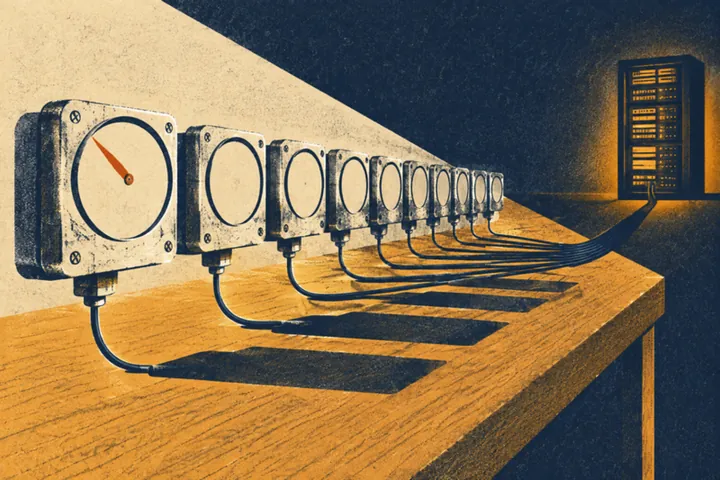
The Ratepayer Pays First
Data centers pay for the wires they cause. The higher capacity price their demand sets reaches every household in PJM first. DeepStack reads both bills and names the federal price data and the December auction that will test the view.
The DeepStack CallMixed
Data centers pay for their own wires. The higher capacity price their demand sets lands first on every PJM household's bill.
- Compare medians, not states: PJM's nine rose a median 11.7% per kilowatt-hour in the year to July, against 5.6% elsewhere.
- Separate the wire from the scarcity: pledges fund the upgrades a project triggers; the capacity price reaches every PJM bill.
- Mark December 9: PJM's auction for 2029/2030 shows whether the price ceiling still binds.
The numbers that moved
- 10-year Treasury
- 5.24%
- −4 bp this week
- 2-year Treasury
- 4.80%
- −3 bp this week
- 30-year Treasury
- 5.60%
- −3 bp this week
- 10-year real yield
- 2.91%
- −1 bp this week
- S&P 500
- 7,812
- +1.2% this week
- Brent crude
- $125.44
- +10.1% this week
Data: U.S. Treasury; S&P Dow Jones Indices via FRED; EIA via FRED
Notes under pressure · 5 of 5
Note 04 · Above the 5% line
The equity cushion is almost gone.
What would change our read. Our read eases if the 10-year closes below 5.00%, or if forward earnings rise about 9% at today’s prices. That would cut the multiple to 17.4x and restore a 50-basis-point cushion.
Note 01 · Curve steepening
The long end is doing the tightening.
What would change our read. If the long end falls while the Fed holds, the market is pricing weaker growth rather than heavier supply. Cheaper long money would ease the financing math in Parts 03 and 08, and we would say so.
Note 03 · Input costs rising
The cheap electron is American.
What would change our read. If US gas climbs toward European levels, or copper breaks lower on slowing grid orders, the scarcity premium in Part 06 is moving, and our read moves with it.
Note 02 · Profits ahead of productivity
Profits are running ahead of productivity.
What would change our read. Productivity growth above 2% a year for two straight quarters would start to close the gap. A fall in profits with productivity flat would tell us the denominator was borrowed.
Note 05 · Real money is expensive
Debt is a contract written in real terms.
What would change our read. A 10-year real yield back below 2% would cut the real cost of the buildout’s debt. Breakevens rising toward 3% would mean the bond market has started to believe the households.
Chart of the week · Live
Profits ran ahead of the economy
US corporate profits against output per hour, both indexed to 100. Move the starting line and watch the gap Part 10 calls the denominator.
Run the numbers yourselfAlso in The Buildout
Part 12Markets
The Model Is Not the Price
The token is cheap and getting cheaper; the labs' revenue is counted in the tens of billions, and none of it is audited on EDGAR. DeepStack reads the model's price as a four-month lease and the lab's price as a line in a filing the public has yet to read.
Part 11Markets
The Backlog Is Not the Quarter
AI suppliers report record order books. DeepStack reads the near book as revenue, the far book as a promise and the margin as the number that arrives last.
Part 10Markets
The Bubble Is in the Denominator
AI spending made the market look cheaper. The harder test is whether those profits survive depreciation, weak productivity and a bond market financing the buildout.
Results · one test came in
Refuted Oct 10, 2026 · Part 03
Refuted: the investment-grade spread ended the window five basis points wider than August's average.
The ICE BofA US Corporate Index option-adjusted spread read 0.85% on October 2, 2026, the end of the four weeks after Labor Day, against an average of 0.80% over August's 21 daily readings (FRED series BAMLC0A0CM). The difference is +0.05%, five basis points, outside the 3 basis point band the rule names, so the answer to the question is no: the market did not price the window tighter than August.
The Docket: dates that will settle the argument
- Oct 15, 2026
Treasury publishes August foreign holdings; renewed Japanese buying despite poor hedged returns would undercut the missing-buyer thesis behind the long-end selloff.
Part 07: The Fed Hiked. The Long End Still Climbed. - Oct 20, 2026
The federal price data for August: whether the median twelve-month rise in household prices across PJM's nine jurisdictions stays at least four points above the median of the other 42, from 11.7% against 5.6% in July.
Part 13: The Ratepayer Pays First - Oct 20, 2026
September-quarter results test cash flow toward $2 trillion and whether maintenance costs enter accounting.
Part 08: AI Lenders Are Financing the End of Scarcity - Oct 28, 2026
Alphabet, Microsoft and Meta report, and the Fed decides the same day: whether the TPU system sales inside Google Cloud's backlog get a size, and whether Cloud growth holds near the second quarter's 82% without them.
Part 12: The Model Is Not the Price