The Buildout · Part 14Capital and credit
The Cash Arrives Unevenly
Microsoft, Alphabet, Amazon and Meta spent 96 cents on property and equipment for each dollar of operating cash in the second quarter of 2026, up from 65 cents across 2025, by DeepStack's reading of SEC filings. Microsoft still pays from its own cash. Amazon spent $1.38 per dollar in the first half.
Where this Part stands
- The Call
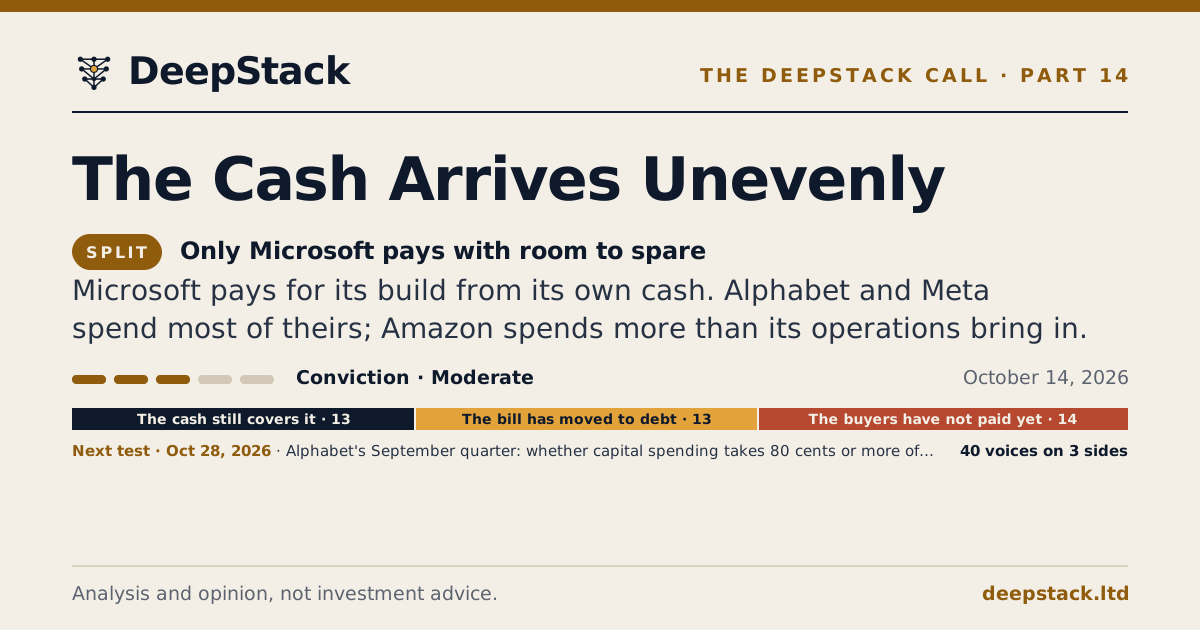
SplitOnly Microsoft pays with room to spare.
Microsoft pays for its build from its own cash. Alphabet and Meta spend most of theirs; Amazon spends more than its operations bring in.
Conviction Moderate · 3 of 5
- The next test
What is established, and what remains uncertain
- What is established
- Microsoft, Alphabet, Amazon and Meta spent 96.1 cents on property and equipment for each dollar of operating cash in the second quarter of 2026, against 64.8 cents across 2025 (SEC filings; DeepStack calculation).
- In the first half of 2026 Microsoft spent 65.3 cents of each operating dollar and kept $35.4 billion; Amazon spent $1.38 for each dollar (SEC filings; DeepStack calculation).
- Alphabet sold $49.6 billion of stock in June 2026 and Meta borrowed $24.9 billion of long-term debt in the second quarter (company releases, July 22 and July 29).
- What remains uncertain
- Whether Alphabet's build takes 80 cents or more of each operating dollar in the September quarter, on October 28 (test p14-t01).
- Whether the four's purchases top their operating cash for the September quarter (test p14-t02) and for 2026 (test p14-t04).
- Who pays at the top: the labs' run-rates are not audited revenue, and analysts expect tech's cash to grow far faster than its customers'.
What is established and what remains uncertain: approved by Marco Cauduro on October 12, 2026.
Explain the mechanism Inspect the evidence Read the countercase See the test
On August 8, Market Sentiment set the bar for the three largest clouds: roughly $600 billion of capital spendingCash a company spends on long-lived assets: data centers, chips, networks, power. More → in 2026 needs about $960 billion of cloud revenue, against a combined run-rate it put near $380 billion and growing more than 40% a year. Demanding, it concluded, but within reach: in its model, $100 billion a year of data center spending sustains about $160 billion of revenue at a return near 21%. Nineteen days later, Hayden Capital put the four largest spenders close to $800 billion for 2026 and wrote in its August 27 letter that their capital spending was about to overtake their internal cash flow, so that for the first time the gap would need outside capital. One reading has the build paying for itself; the other has it outrunning the cash meant to pay for it.
The filings settle it company by company. Microsoft, Alphabet, Amazon and Meta took in $171.8 billion of operating cash in the second quarter of 2026 and spent $165.1 billion on property and equipment, by DeepStack's reading of their filings in the SEC's XBRL data on October 12, 2026. That is 96.1 cents of each dollar, against 64.8 cents across 2025, when they spent $376.1 billion of $580.5 billion. Free cash flowOperating cash flow minus capital spending: the cash left after the company has paid for its own buildout. More → here is operating cash minus purchases of property and equipment, the definition Alphabet uses for itself, and the count leaves out Oracle.
The average hides four different companies. In the first half of 2026 Microsoft spent 65.3 cents of each operating dollar and kept $35.4 billion. Meta spent 76.6 cents and kept $15.0 billion. Alphabet spent 95.0 cents, after 55.5 cents across 2025, and its second quarter ran $5.9 billion short, $44.9 billion of purchases against $39.1 billion of operating cash, its July 22 release shows. Amazon spent $1.38 for every dollar its operations brought in and ran $27.0 billion short. Its own measure, net of equipment sales and incentives, shows a $7.6 billion outflow over the twelve months to June 2026, it reported on July 30.
The bill is rising faster than the cash. The four's operating cash grew 33% in the first half of 2026 from a year earlier, to $322.5 billion; their purchases grew 84%, to $294.8 billion. Part fourteen asks whether AI revenue is arriving fast enough for the biggest spenders to pay for their data centers out of their own cash.
DeepStack read 194 posts, fund letters and episodes by 87 voices, all but one published between July 15 and October 11, 2026, and verified 245 agreements and 121 disagreements, 30 of them direct contradictions or refutations. The readings split three ways: the spenders' cash covers the build, the bill has moved to debt, or the end buyers have not paid yet.
The cash still covers it
In the second quarter of 2026 Google Cloud's revenue rose 82% to $24.8 billion and its operating income reached $8.8 billion, from $2.8 billion a year earlier, Alphabet reported on July 22. AWS sales rose 37% to $42.2 billion and its operating income to $16.6 billion, from $10.2 billion, Amazon reported on July 30. Revenue from Azure and other cloud services grew 43% in Microsoft's quarter ended June 30, 2026, its July 29 release shows.
Aurelion Research noted on September 11 that the spenders' operating margins were still rising, giving them room to keep paying. Ren wrote on October 5 that hyperscalerOne of the largest cloud and platform companies that build data centers at continental scale. More → cash flows and multi-year contracts fund the buildout. Oguz Erkan argued on August 23 that Meta's committed capital already earns a return in the core business and that internal deployments can be delayed or cancelled.
The defense of the negative quarters is timing. Invest In Assets read the market on August 5 as rewarding Amazon's raised guidance of roughly $220 billion, because Amazon was showing returns on what it spends. On August 11 it relayed management's account: about two years of construction before any revenue, three decades of use, and roughly three years to break even on servers that last five or six. Negative free cash flow, on that account, is the cost of building many sites at once.
DeepStack's reading is that this side has the cloud segments right on the return clock, which runs for the life of a chip. The cash clock runs by the quarter, and in the second quarter of 2026 three of the four ran short or raised outside money.
The bill has moved to debt
The four had not crossed the line by June; two of them had. Ed Elson of Prof G Markets noted on August 11 that Google had spent $45 billion and Amazon $54 billion in a single quarter and that both ended with negative cash flow. The SEC data agree for the second quarter of 2026: Alphabet ran $5.9 billion short, Amazon $8.8 billion.
The financing sections show where the difference went. In June 2026 Alphabet sold $49.6 billion of common and mandatory convertible preferred stock, for purposes that include capital spending on AI infrastructure, its July 22 release says. It raised $24.8 billion of debt in the quarter, ended June with $98.2 billion of long-term debt against $46.5 billion at the close of 2025, and bought back no stock in the first half. Meta's July 29 release shows $24.9 billion of new long-term debt in the second quarter, no buybacks and $90.3 billion of cash and marketable securities still on hand on June 30. Its free cash flow was $784 million on Meta's own definition, which also subtracts finance-lease principal, and $1.7 billion on DeepStack's. Amazon raised $67.0 billion from long-term debt in the first half of 2026, $13.6 billion of it in the second quarter, by DeepStack's reading of the same SEC data.
JunkBondInvestor counted on August 9 about $400 billion of hyperscaler debt issuance penciled in for 2027, with AI-related paper at about 6% of the investment-grade index, double its share a year earlier. Torsten Slok of Apollo wrote on September 12 that the spenders had raised every dollar they sought, at a rising price: spreadsThe extra yield a borrower pays above a Treasury of the same maturity, in basis points. More → on their longest bonds had widened, and most of their 2026 issues traded wider than at sale. Michael Burry counted on September 19 roughly $2.7 trillion of uncommenced leases and purchase commitments across five hyperscalers, off the balance sheet, against combined earnings below $400 billion over the past year.
DeepStack reads the cash flow statement and the financing section together. In the second quarter of 2026 Alphabet and Amazon sold stock or borrowed to cover a shortfall, and Meta borrowed $24.9 billion with $1.7 billion left after building. Burry's commitments, counted across five companies, are the part of the bill not yet presented.
The buyers have not paid yet
Slok set the long clock on September 29. Analysts covering technology expect the sector's operating cash flow to more than double to about $2.4 trillion by 2028, he wrote, while analysts covering the other S&P 500 sectors, tech's customers, expect those companies to add much less. One forecast has to give, and he asked who will write the checks for AI services. His September 21 note put the same assumption under the spenders' credit: consensus, on FactSet data for Alphabet, Meta, Amazon, Microsoft and Oracle, has their operating cash flow more than tripling, from $600 billion to $2 trillion, by 2030.
Market Sentiment read the gap the other way on September 17: next year's $1.2 trillion or more of AI spending should drive about $2 trillion of incremental revenue. DeepStack found the two in direct contradiction. Daniel Romero counted on September 21 that a one-year payback on a hypothetical 2027 buildout would take $1.9 trillion to $2.28 trillion a year in compute payments. Ren sketched the 2030 stack on October 6, spending $3 trillion to $4 trillion a year on hardware while applications and models bring in about $2.1 trillion. Other businesses, debt and depreciationThe accounting charge that spreads an asset's cost over the years it is assumed to last. More → can carry the gap for a while, he wrote, but it closes from the top, and borrowers feel a late $2.1 trillion first.
The top, for now, is two labs. Steve Eisman, on The Real Eisman Playbook, traced on September 21 roughly 70% of the hyperscalers' AI revenue to OpenAI and Anthropic, both burning large amounts of cash. Tae Kim relayed on October 2 that Axios and the Financial Times put OpenAI's annual recurring revenue near $70 billion; Michael Spencer of AI Supremacy wrote on October 9 that a later Financial Times report found about $50 billion. Neither run-rate is audited revenue; nor is Microsoft's $678 billion of commercial remaining performance obligationsContracted revenue a company has not yet recognized; the filing's name for backlog. More → at the end of June 2026, work contracted but not yet delivered.
Longriver Investment Partners warned in its July 20 letter that AI can transform business and still fail its builders, because revenue can arrive well before owner earnings. First Pacific Advisors counted on July 30 that $2.59 trillion of AI spending in 2026 would need $207 billion a year of after-tax income from the start to earn even a low return.
Four wallets, one ruler
DeepStack's reading is that each side describes one wallet. The first is right about Microsoft, whose cloud and other businesses paid for the build with $35.4 billion left over in the first half of 2026. The second is right about Amazon, which spent more than its operations brought in and borrowed $67.0 billion in the first half. It is partly right about Meta, which builds for its own products, has no cloud to rent out and borrowed $24.9 billion in the second quarter while its cash still covered the build. Alphabet sits between them, with the fastest-growing cloud of the three and a negative quarter. The third side owns the long clock, and no filing will answer Slok's question before 2027.
- Microsoft, 202551.8%
- Microsoft, H1 202665.3%
- Meta, 202560.2%
- Meta, H1 202676.6%
- Alphabet, 202555.5%
- Alphabet, H1 202695.0%
- Amazon, 202594.5%
- Amazon, H1 2026137.8%
- The four, 202564.8%
- The four, H1 202691.4%
Source: SEC XBRL company filings, read Oct 12, 2026; DeepStack calculation (Amazon: purchases of property and equipment, gross of sales and incentives)
In 2025 the four spent between 51.8 cents (Microsoft) and 94.5 cents (Amazon) of each operating dollar on the build. By the first half of 2026 every one of them had moved up, and the gap between the two had widened to 72.5 cents.
The guidance points to a heavier second half of 2026 for the other three. Alphabet's $195 billion to $205 billion for the year, as Kingswell reported it on July 24, leaves $114 billion to $124 billion after $80.6 billion in the first half. Its operating cash was $100.8 billion in the second half of 2025; at the first half's 33% growth the build would take 85 to 93 cents of each dollar. Meta's $130 billion to $145 billion, finance-lease principal included, as it guided on July 29, leaves $79 billion to $94 billion after $50.9 billion on the same basis, against about $86 billion of operating cash if its first-half growth of 29% holds. The roughly $220 billion Invest In Assets cited for Amazon on August 5 leaves more than $120 billion after $98.4 billion, against about $130 billion of operating cash at its first-half growth of 44%. Erkan named the consequence on August 6: if free cash flow goes negative in 2027, spending past that point needs visible returns.
At Microsoft the cash has arrived. At Alphabet and Amazon the bill came first.
One calendar effect cuts the other way. The September quarter usually brings in more cash than the June quarter, by an amount that varies: the four's operating cash rose from $128.5 billion to $159.0 billion in 2025 and from $108.5 billion to $115.6 billion in 2024, by DeepStack's reading of the same filings. With those budgets and either year's pattern, the four land between about 84 and 108 cents of each dollar in the September quarter and between about 88 and 101 cents for 2026. One quarter can understate the strain; the house reads the year too.
The tests ahead
Alphabet reports on October 28, and Microsoft the same afternoon. The first line to track is Alphabet's capital spending per dollar of operating cash in the quarter ended September 30, 2026: 49.5 cents a year earlier, 95.0 cents in the first half of 2026. At 80 cents or more, the build is still taking most of the cash in the quarter when cash runs strongest. With the quarterly reports due on EDGAR by November 9, the second line is whether the four's combined purchases topped their combined operating cash in the same quarter, after 96.1% in the June quarter of 2026. DeepStack expects them to stay under it, narrowly.
By February 12, 2027, Alphabet, Amazon and Meta will have given their 2027 budgets; the test is whether the midpoints sum to at least 25% more than the three spent in 2026. On February 16, the annual filings say whether the four's purchases topped their operating cash across 2026, after 91.4% in the first half.
Two results in the September quarter would prove DeepStack wrong: Alphabet under 80 cents of each operating dollar, its cash catching up with its build, or Microsoft above 85 cents, the strongest cloud no longer paying its own way. The four crossing the line would move the house toward the debt reading.
At Microsoft the cash has arrived. At Alphabet and Amazon the bill came first. Meta's budget runs close to its cash, and until the tenants pay, the financing section holds the difference.
The DeepStack call
SplitOnly Microsoft pays with room to spare
Microsoft pays for its build from its own cash. Alphabet and Meta spend most of theirs; Amazon spends more than its operations bring in.
What to do with this
- Divide capital spending by operating cash, company by company: in the first half of 2026 Microsoft spent 65.3%, Amazon 137.8%.
- Hold free cash flow to one ruler: Meta's own measure gave $784 million for the June quarter of 2026; cash less purchases, $1.7 billion.
- Read the financing section beside the spending line: Alphabet sold $49.6 billion of stock in June 2026, and Meta borrowed $24.9 billion.
What would change our mind
- Alphabet spends under 80 cents of each operating dollar in the September quarter: its cash is catching up with its build.
- Microsoft's purchases pass 85% of its operating cash in the September quarter: even the strongest cloud stops paying its way.
- The four's purchases top their operating cash for the September quarter or for 2026: the group stops paying, toward the debt side.
Next test
All 4 testsRead the full argument
DeepStack's view is that only Microsoft pays for its build with room to spare. In the first half of 2026 it spent 65.3 cents of each operating dollar on property and equipment and kept $35.4 billion. Meta spent 76.6 cents and borrowed $24.9 billion in the second quarter; Alphabet spent 95.0 cents and sold $49.6 billion of stock in June; Amazon spent $1.38 for each dollar its operations brought in. As a group the four still pay, narrowly: the guidance points to more spending in the second half, and the cash runs stronger after June. The single most important reason for caution is the calendar: the September quarter brings in more cash than the June quarter, so one quarter can understate the strain. The view changes if Alphabet spends under 80 cents of each operating dollar in the September quarter, or if Microsoft spends more than 85 cents. The first answer arrives on October 28.
Call history
- v2Only Microsoft pays with room to spareConviction Moderate (3/5)SynthesisSide named by the owner.
- v1Only Microsoft pays with room to spareConviction Moderate (3/5)First call, with the story.
The numbers behind the Call96.1%137.8%$35.4B-$5.9B
Analysis and opinion, not investment advice.
What to watch
Alphabet's September quarter: whether capital spending takes 80 cents or more of each dollar of operating cash, after 49.5 cents a year earlier and 95.0 cents in the first half of 2026. Pre-specified
- Question
- Did Alphabet's purchases of property and equipment for the quarter ended September 30, 2026 equal 80% or more of its net cash provided by operating activities for the same quarter?
- Source
- SEC EDGAR, Alphabet filings (the earnings release on Form 8-K and the Form 10-Q for the quarter), CIK 0001652044
- Rule
- Take the three-month figures from the statement of cash flows in Alphabet's earnings release; if the release gives only year-to-date figures, use the nine-month figure less the six-month figure from the Form 10-Q. Divide purchases of property and equipment by net cash provided by operating activities. The answer is yes if the ratio is 80.0% or more; no if it is below 80.0%. Alphabet's own free cash flow line, finance leases and its spending guidance for the year are read alongside and do not decide the test.
- If the source is late, revised or silent
- Alphabet has scheduled the release for October 28, 2026. If neither the release nor a Form 10-Q states the quarter's cash flow figures on EDGAR by November 9, 2026, the test is inconclusive, and the Result says what was read and what was missing; the next reading is November 16, 2026. Figures are read as first filed; a later amendment does not reopen the test.
The Call, before the dateExpects yes. Gives the yes answer 70%.
0 · no100 · yes
I expect:The four's September-quarter reports on EDGAR: whether combined purchases of property and equipment topped combined operating cash, after 96.1% in the June quarter of 2026. Pre-specified
- Question
- Did the combined purchases of property and equipment of Microsoft, Alphabet, Amazon and Meta for the quarter ended September 30, 2026 exceed their combined net cash provided by operating activities for the same quarter?
- Source
- SEC EDGAR, the Forms 10-Q of Microsoft, Alphabet, Amazon and Meta for the quarter (statements of cash flows; XBRL company facts)
- Rule
- Read each company's statement of cash flows for the quarter; where a Form 10-Q gives only year-to-date figures, the quarter is the later cumulative figure less the earlier one from the same fiscal year (for Microsoft, the first quarter of its fiscal 2027). For Amazon, purchases are the gross line, before proceeds from sales and incentives. Sum the four purchases and the four operating figures. The answer is yes if combined purchases exceed combined net cash provided by operating activities; no if they are equal or lower. Each company's own ratio and free cash flow measure are read alongside and do not decide the test.
- If the source is late, revised or silent
- If any of the four Forms 10-Q is not on EDGAR by November 9, 2026, the filing deadline for large companies, the test is inconclusive on November 10, and the Result says what was read and what was missing; the next reading is November 16, 2026. Figures are read as first filed; a restated earlier quarter in the same filings is named in the Result and does not change the reading.
The Call, before the dateExpects no. Gives the yes answer 40%.
0 · no100 · yes
I expect:The 2027 budgets of Alphabet, Amazon and Meta: whether the midpoints sum to at least 25% more than the three spent in 2026. Pre-specified
- Question
- Do the midpoints of the 2027 capital expenditure guidance that Alphabet, Amazon and Meta give with their fourth-quarter 2026 results sum to at least 25% more than the three companies' 2026 capital expenditures?
- Source
- Investor-relations pages of Alphabet (abc.xyz/investor), Amazon (ir.aboutamazon.com) and Meta (investor.atmeta.com): fourth-quarter 2026 earnings releases and call transcripts
- Rule
- Each company's 2026 capital expenditures and its 2027 guidance are read as that company defines capital expenditures in the release or on the call that gives the guidance (for Meta, including principal payments on finance leases). A range counts at its midpoint; a single figure counts as given; a floor stated as at least or more than a figure counts at that figure. The answer is yes if the three 2027 figures sum to 1.25 times the three 2026 figures or more; no if the sum is below that. Microsoft gives no calendar-year figure and is not part of the test.
- If the source is late, revised or silent
- If any of the three gives no 2027 figure by February 12, 2027, the test is inconclusive, and the Result says what was read and what was missing; the next reading is that company's first-quarter 2027 results, by May 15, 2027. Guidance revised after the first statement does not reopen the test.
The Call, before the dateExpects yes. Gives the yes answer 55%.
0 · no100 · yes
I expect:The full year: whether the four's purchases topped their operating cash across calendar 2026, after 91.4% in the first half. Pre-specified
- Question
- Did the combined purchases of property and equipment of Microsoft, Alphabet, Amazon and Meta for the four calendar quarters of 2026 exceed their combined net cash provided by operating activities for the same quarters?
- Source
- SEC EDGAR, the 2026 annual reports (Form 10-K) of Alphabet, Amazon and Meta and Microsoft's Forms 10-K and 10-Q covering January to December 2026 (statements of cash flows; XBRL company facts)
- Rule
- Sum, for each company, January 1 to December 31, 2026: Alphabet, Amazon and Meta from their annual statements of cash flows; Microsoft from the four quarters of its fiscal 2026 and 2027 that fall in the calendar year, each the later cumulative figure less the earlier one. For Amazon, purchases are the gross line, before proceeds from sales and incentives. The answer is yes if combined purchases exceed combined net cash provided by operating activities; no if they are equal or lower. Each company's own free cash flow measure is read alongside and does not decide the test.
- If the source is late, revised or silent
- If any of the filings is not on EDGAR on February 16, 2027, the reading waits; if one is still missing on March 1, 2027, the annual-report deadline for large companies, the test is inconclusive, and the Result says what was read and what was missing; the next reading is March 15, 2027. Figures are read as first filed; a restated quarter is named in the Result and does not change the reading.
The Call, before the dateExpects no. Gives the yes answer 30%.
0 · no100 · yes
I expect:
Follow
Follow Part 14: one email when one of its tests resolves.
Sources and further reading (25)
- Market Sentiment - Is the capex sustainable?
- Hayden Capital - Q2 2026 letter
- U.S. Securities and Exchange Commission - EDGAR XBRL company data
- Alphabet - Second quarter 2026 results (Form 8-K, Exhibit 99.1)
- Amazon - Second quarter 2026 results
- Microsoft - Fourth quarter fiscal 2026 results
- Aurelion Research - In Conversation: NVIDIA
- Oguz Erkan, Capitalist Letters - META Deep Dive: Opportunity or a Trap?
- Invest In Assets - Factsheet July 2026
- Invest In Assets - Why I'm Bullish on Amazon
- Ed Elson, Prof G Markets - Plastic Surgery
- Meta - Second quarter 2026 results
- JunkBondInvestor - Credit Weekly: What If They Just Keep Borrowing?
- Torsten Slok, Apollo - From a Savings Glut to a Savings Shortage
- Torsten Slok, Apollo - Tech's Trillion-Dollar Internal Inconsistency
- Torsten Slok, Apollo - Hyperscaler Credit Rests on One Consensus Assumption
- Market Sentiment - The next great AI trade is everything that isn't AI
- Daniel Romero, HyperTech Invest - The Math Behind the Next AI Rally
- Michael Spencer, AI Supremacy - AI off the Charts II
- Longriver Investment Partners - Q2 2026 letter
- First Pacific Advisors - Q2 2026 letter
- Kingswell - The Berkshire Beat: July 24, 2026
- Oguz Erkan, Capitalist Letters - It's Time To Be Bullish On Compute, Again
- Alphabet - Date of third quarter 2026 results
- Microsoft - Quarterly earnings release date
Market data are as of the dates cited.