The Buildout · Part 19Capital and credit
The Interest Bill Comes First
CoreWeave paid 24.9 cents of net interest on every dollar of revenue in the second quarter of 2026. Oracle bridged a $20.8 billion gap in its quarter to August 31 with customers' prepayments and $19.9 billion of new stock. Customers and shareholders carry Oracle; lenders carry what the neoclouds' customers do not prepay, and CoreWeave's interest bill is rising.

Where this Part stands
- The Call
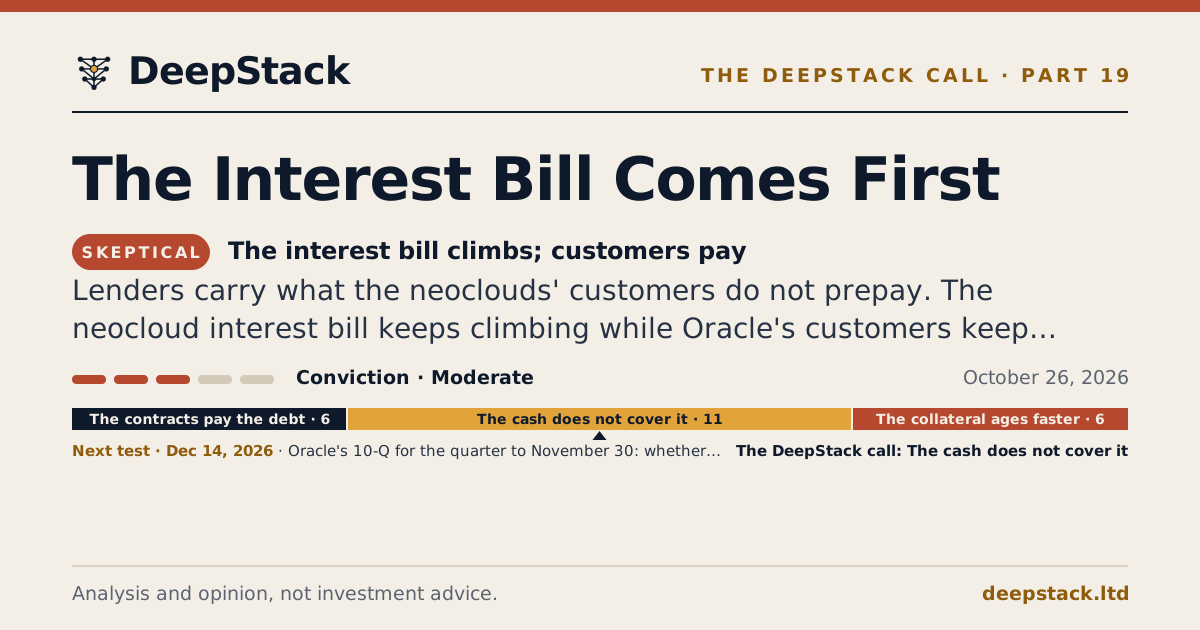
SkepticalThe interest bill climbs; customers pay.
Lenders carry what the neoclouds' customers do not prepay. The neocloud interest bill keeps climbing while Oracle's customers keep paying.
Conviction Moderate · 3 of 5
- The next test
What is established, and what remains uncertain
- What is established
- Oracle's operating cash without its two deferred revenue lines was $7.7 billion against $28.5 billion of capital spending in the quarter to August 31, 2026, and share sales added $19.9 billion (Oracle Form 10-Q; DeepStack calculation).
- CoreWeave's net interest expense was 24.9% of revenue in the second quarter of 2026, from 22.0% a year earlier (CoreWeave results release, August 11, 2026; DeepStack calculation).
- S&P cut Oracle to BBB-, its lowest investment grade, on July 9, 2026, with a stable outlook, and rates CoreWeave B+ with a positive outlook (S&P Global Ratings, July 9 and June 11, 2026).
- What remains uncertain
- Whether Oracle's financed prepayments keep arriving in its second quarter (test p19-t01, December 14).
- Whether CoreWeave's net interest reaches 25% of revenue in the quarter to December 31, 2026, reported in late February 2027 (test p19-t03).
- Whether a listed neocloud reports a bankruptcy or accelerated debt by June 30, 2027 (test p19-t04).
What is established and what remains uncertain: approved by Marco Cauduro on October 13, 2026.
Explain the mechanism Inspect the evidence Read the countercase See the test
Clark Tang, a partner at Altimeter, looked at CoreWeave's collateral on August 12, 2026, and saw an airplane. In a guest post on Tae Kim's Key Context, he noted that CoreWeave had contracted six-year-old A100 chips through 2029 and raised prices across its fleet 25% in July, and wrote that the collateral was aging more like an aircraft than a smartphone. Eight days later Kakashii ran the second quarter through the most generous version of that premise. Stretch the life of CoreWeave's GPUs from six years to twelve, cut Nvidia's gross margin from above 70% to 35% and pass every dollar of the saving to CoreWeave, and the company would still post a recurring pretax loss of about $39 million, because a longer accounting life saves no cash and the debt still has to be paid.
The two disagree about which bill arrives first, the one for the asset or the one for the money that bought it. Part nineteen asks whether Oracle and the neoclouds, the specialist GPU landlords, can carry the buildout they signed. Parts three and eight argued that the credit stack is where this cycle breaks, and Part eleven set Oracle's backlogOrders a company has accepted but not yet delivered or recognized as revenue. More → against its quarter. This Part names the floor that comes under strain first. DeepStack read 135 filings, calls, posts and letters by 53 voices and verified 69 disagreements, 23 of them contradictions or refutations, against 102 agreements.
The contracts pay the debt
CoreWeave made the first side's case itself on its call of August 11, 2026. Management called the second quarter the point where scale became operating leverage: revenue of $2.6 billion, up 112%, a backlog of $104.2 billion and adjusted operating income of $128 million. Nitin Agrawal, its finance chief, said prices rose about 25% across its products in July and that contracts signed in the quarter carry contribution margins 5 to 10 points above recent ones. A typical five-year contract, he said, is underwritten so that the asset-level debt behind it is repaid within the term, and the company's weighted average cost of debt had fallen almost 300 basis pointsOne hundredth of a percentage point: 25 basis points is 0.25%. More → over the year.
Nebius told analysts on August 12 that its four large mid-term deals of the second quarter yield $20 million to $25 million per megawattA unit of power: a megawatt serves a few hundred homes, a gigawatt a city; data centers are sized in both. More →, with upfront payments covering 50% to 60% of the capital spendingCash a company spends on long-lived assets: data centers, chips, networks, power. More → behind them. IREN's results of August 27 put recent customer prepayments at 45% to 55% of GPU capital spending. Daniel Romero of HyperTech Invest wrote on August 29 that IREN had sold out its 2026 capacity and pre-sold about a quarter of what it plans to bring online in the first half of 2027.
The side's strongest evidence is the price lenders ask when a strong customer stands behind a cluster. CoreWeave told investors on September 17, 2026 that its asset-level loans earn investment-grade ratings when the customers are investment grade, and that its delayed-draw term loan DDTL 4.0 was rated the equivalent of A- by three agencies. S&P Global Ratings has rated CoreWeave itself B+ with a positive outlook since April 9, 2026, kept both on June 11 and wants a longer record of managing customer concentration, funding needs and access to capital before it raises the rating.
DeepStack's reading is that this side describes the contract correctly and the company incompletely. An asset-level rating looks through the borrower to its customer, and a contract that repays its own debt in five years protects the lender on that cluster. The company that pays the interest is rated B+, four notches below investment grade, and the contract does not pay the interest on the next cluster, which is being built before the first one earns out.
The cash does not cover it
The second side does the cash arithmetic. Kakashii counted on August 20 that CoreWeave spent $14.12 billion on property and equipment in the first half of 2026 while operations produced $3.66 billion, so operating cash covered 26% of the spending. In the second quarter alone it covered 11%, and debt principal stood at $35.55 billion on June 30, against $8.03 billion at the end of 2024. CoreWeave's release for the quarter gives the line DeepStack holds to: net interest expense of $640 million on revenue of $2,575 million, or 24.9%, against $267 million on $1,212 million, or 22.0%, a year earlier.
- CoreWeave, Q2 202624.9%
- CoreWeave, Q2 202522.0%
- Oracle, qtr to Aug 31, 20267.4%
- Oracle, qtr to Aug 31, 20256.2%
Source: CoreWeave Q2 2026 results release (Form 8-K, Aug 11, 2026); Oracle Form 10-Q for the quarter ended Aug 31, 2026; DeepStack calculation
Both of CoreWeave's numbers on debt are true at once. Its rate fell almost 300 basis points over the year; Moses Sternstein of a16z wrote on August 14 that its interest expense was rising all the same, with depreciationThe accounting charge that spreads an asset's cost over the years it is assumed to last. More → on its chips above half of revenue. A lower price on a much larger balance is still a larger bill.
July is where the two sides read one event in opposite directions. JunkBondInvestor reported on August 3 that CoreWeave sought a $2.6 billion loan on July 20, launched it at a spreadThe extra yield a borrower pays above a Treasury of the same maturity, in basis points. More → of 425 to 450 basis points at 99 cents, and cleared it at 550 over at 97, about 10.4% to lenders against the mid-8s first shown. CoreWeave told its call on August 11 that the loan priced at full size in one of the year's most dislocated weeks for credit, and that a delayed-draw structure backed by shorter contracts had opened a market that financing, not demand, had kept shut. Both statements hold, and the market opened at a higher price. On September 20 JunkBondInvestor added that CoreWeave's convertible coupon had risen from 1.75% in April to 2.875%.
On June 28 the same writer had drawn the stack: senior asset-backed debt on data center leases clearing near 120 basis points, neocloud corporate debt nearer 600, where the lender takes the risk of the whole enterprise. Oguz Erkan of Capitalist Letters, bullish on compute, wrote on August 6 that the depressed valuations of Oracle and CoreWeave show how little investors like leverage that depends on speculative returns.
The customer is Oracle's bridge
Oracle's bridge is built of other people's money, and its 10-Q for the quarter to August 31, 2026 prints each span. Operating cash was $23.1 billion. Of that, $11.4 billion came from customer prepayments that Oracle says carry a significant financing component, and $4.0 billion from other deferred revenue. Strip both out and operations made $7.7 billion against $28.5 billion of capital spending, a gap of $20.8 billion in one quarter. Shareholders supplied $19.9 billion: Oracle sold 141 million shares and, in the filing's words, fully utilized its at-the-market program. Kakashii drew the same bridge on September 24, reached the same $7.7 billion and put the share sale at 51% of the cash Oracle held at the quarter's end.
That quarter sits on a longer hole. Oracle's first-quarter release of September 10 shows free cash flowOperating cash flow minus capital spending: the cash left after the company has paid for its own buildout. More → of minus $5.4 billion for the quarter; by DeepStack's sum of the release's quarterly columns, minus $28.7 billion for the twelve months to August 31, 2026. The same 10-Q lists $288 billion of leases signed and not yet begun, substantially all for data centers, and $664 billion of remaining performance obligationsContracted revenue a company has not yet recognized; the filing's name for backlog. More →, about 13% of it due as revenue within twelve months. S&P Global Ratings cut Oracle to BBB-, the lowest investment grade, on July 9, 2026, with a stable outlook, expecting its adjusted leverage to stay above 4 times for two years. S&P named three grounds for another cut: leverage held above 4.5 times, Oracle losing its path to positive free operating cash flow by fiscal 2029, or a negative view of Oracle's AI strategy or the industry's. The other two agencies sit higher. Moody's rates Oracle Baa2, two notches above junk, and kept its outlook negative when it affirmed the rating on February 2, 2026; Fitch Ratings affirmed BBB with a stable outlook the same day. Michael Spencer of AI Supremacy wrote on October 1 that one more notch would make Oracle a fallen angel and force index and pension holders out of roughly $120 billion of its bonds. It would take more than one notch. The largest bond indexes classify a bond by the middle of its three ratings, so an S&P cut alone leaves Oracle in them; a second agency would have to fall two notches.
Kakashii's reading of September 24 is that Oracle entered the AI era already carrying tens of billions of debt, which limited what it could build and buy on its own. The same 10-Q shows why that debt is not yet the binding cost. Interest expense was $1.43 billion in the quarter to August 31, 2026, 7.4% of $19.35 billion of revenue, against 6.2% a year earlier. Oracle pays its interest from operations and, for now, its capital spending with its customers' money.
The customer pays for Oracle's buildout. The lender pays for the neoclouds', and charged CoreWeave more in July and September.
The customer bridge carries other people's debt as well. Leyla Kunimoto of Accredited Insight wrote on October 5 that Oracle is not the borrower on the $18 billion Project Jupiter construction loan, yet its rent is the loan's main source of cash once the lease begins. The project's lenders are exposed through Oracle's rent and the timetable on which it begins, and this Part does not rank them against the two floors it does.
The same bridge runs under the neoclouds, and it is the weakest span in their case. Ren wrote on August 3 that Nebius is the exception among them, funding capital spending from its own cash flow without equity, prepayments or debt. Nebius's own call nine days later contradicted that account: customers' upfront payments cover 50% to 60% of the spending behind its new deals, and management expects financing of GPUs as a stand-alone asset class to become another source of funds. On August 24 Nebius closed $5.75 billion of convertible notes, at 0.50% due 2030 and 4.50% due 2034, with data centers and GPUs among the uses it named. IREN's results of August 27 add that prepayment terms vary and that there is no assurance future contracts will include them.
The collateral ages faster
The third side puts the risk in what the debt is secured by. Michael Burry read Nebius's own terms on August 12 as compute in backwardation: $40 million to $50 million per megawatt for capacity of up to six months against $20 million to $25 million on one- to three-year contracts. Buyers paying twice the rate for near-term use, he argued, means the GPU, the customer or both are losing value, and he noted that Nebius had stretched its server depreciation from four years to five while that pricing implies decay of about 50% a year. Nebius's answer, the same day, was that its short-term buyers are model developers renting GB300 clusters for three- to six-month training runs, paying for speed and certainty of access rather than for a depreciating asset. Kakashii's August 20 account of CoreWeave fits Burry's reading: GPUs that turn obsolete far faster than the buildings around them.
Lenders have priced for that. Daniel Nishball of SemiAnalysis explained on July 6 that banks underwrite GPU debt to the scenario where the backstop is triggered, asking at least 1.3 times debt service coverage, roughly 70% to 80% loan to value, a case in which the neocloud earns close to nothing and still pays the debt. JunkBondInvestor wrote the same day that an obsolete building needs a second construction project before it can be financed again, and an upgrade does not help when the balloon payment comes first. Harris Associates Oakmark warned in its second-quarter 2026 letter that many neocloud issuers lack the protections that preserve a bondholder's principal. DeepStack reads the structure as built to put the first loss on the neocloud's shareholders, and the second on the lender when the asset ages faster than the loan.
The tests ahead
Oracle reports its second fiscal quarter on December 14, 2026, by its investor relations page, and its 10-Q for the quarter to November 30 answers two questions. Does the six-month increase in deferred revenue from customer prepayments with a significant financing component pass $11.363 billion, the first quarter's figure alone? A yes means new prepaid contracts arrived in the second quarter and the customer bridge is still open. Do leases signed and not yet begun pass $288 billion, the August 31 figure? Leases that start leave that line for the balance sheet, so the reading sets the lease liability beside it.
CoreWeave had not dated its next report as of October 12; it reported 2025 on February 26, 2026. Its results for the quarter to December 31, 2026, expected in late February 2027, answer the third question: does net interest expense reach 25% of the quarter's revenue, from 24.9% in the quarter to June 30, 2026? A reading between 22.0%, the level of a year earlier, and 25% leaves the Call standing but unconfirmed. The fourth runs to June 30, 2027: does CoreWeave, Nebius, IREN, Core Scientific, Applied Digital, TeraWulf or Cipher Digital, the former Cipher Mining, report a bankruptcy or an acceleration of its debt to the SEC?
What would prove DeepStack wrong is net interest below 22.0% of revenue in CoreWeave's quarter to December 31, 2026, its level of a year earlier, which would mean the contracts are paying the debt; financed prepayments at Oracle that stop at $11.363 billion for the six months to November 30, which would close the customer bridge and make Oracle the weaker floor; or two agencies cutting Oracle to junk while S&P keeps CoreWeave's B+ on a positive outlook.
The order of the floors follows from the bridge each has left. The neocloud's corporate lender takes the strain first and Oracle second, through the price of its capital. The strain shows as a neocloud interest bill that keeps rising while Oracle's customers keep paying, well before either floor reaches a default or a junk rating; DeepStack puts 15 in 100 on a listed neocloud reporting a bankruptcy or accelerated debt by June 30, 2027. The Call sets the order of the floors, and the dated tests carry its timing. The customer pays for Oracle's buildout. The lender pays for the neoclouds', and charged CoreWeave more in July and September.
The DeepStack call
SkepticalThe interest bill climbs; customers pay
Lenders carry what the neoclouds' customers do not prepay. The neocloud interest bill keeps climbing while Oracle's customers keep paying.
What to do with this
- Read Oracle's operating cash without both deferred revenue lines: $7.7B against $28.5B of capex in the quarter to Aug 31, 2026.
- Divide each neocloud's net interest by its revenue every quarter: CoreWeave's was 24.9% in Q2 2026, from 22.0% a year earlier.
- Treat prepayments as terms that can lapse: IREN put recent ones at 45-55% of GPU capex on Aug 27, 2026, with no assurance they recur.
What would change our mind
- CoreWeave's net interest falls below 22.0% of revenue, its year-earlier level, in the quarter to Dec 31, 2026: the contracts pay the debt.
- Oracle's 10-Q for the quarter to Nov 30 shows six-month financed prepayments at or below $11.363B: the customer bridge has closed.
- Two agencies cut Oracle to junk while S&P keeps CoreWeave's B+ on positive outlook: the order of the floors is wrong.
Next test
All 4 testsRead the full argument
The DeepStack Call is that the neoclouds' interest bill keeps climbing while Oracle's customers keep paying. Oracle's capital spending is being carried by its customers and its shareholders: in the quarter to August 31, 2026, operations without both deferred revenue lines made $7.7 billion against $28.5 billion of capital spending, and prepayments and $19.9 billion of new stock covered the gap. The public neoclouds' spending rests on lenders wherever customers do not prepay: CoreWeave, rated B+ by S&P, paid 24.9% of its second-quarter revenue in net interest and cleared a July loan near 10%. The Call orders the floors and does not need a default; on the way it expects Oracle's financed prepayments to keep arriving in the quarter to November 30, at 75 in 100, and CoreWeave's net interest to reach 25% of revenue in the quarter to December 31, at 55 in 100. The single most important reason for caution is that prepayments are negotiated contract by contract and Oracle's share program was used up in one quarter, so the customer bridge could close faster than the interest bill grows. The Call changes if CoreWeave's net interest falls below 22.0% of revenue, if Oracle's financed prepayments stop at $11.363 billion for the six months to November 30, or if two agencies cut Oracle to junk while S&P keeps CoreWeave's outlook positive. The first answer arrives on December 14, with Oracle's quarter.
Call history
- v2The interest bill climbs; customers payConviction Moderate (3/5)Side: The cash does not cover itSide named by the owner.
- v1The interest bill climbs; customers payConviction Moderate (3/5)First call, with the story.
The numbers behind the Call24.9%$7.7B$19.9B
Analysis and opinion, not investment advice.
What to watch
Oracle's 10-Q for the quarter to November 30: whether its financed customer prepayments for the six months pass $11.363 billion, the first quarter's figure alone. Pre-specified
- Question
- Does Oracle's Form 10-Q for the quarter ended November 30, 2026 report an increase in deferred revenues from customer prepayments with significant financing component, for the six months ended November 30, 2026, above $11.363 billion?
- Source
- SEC EDGAR, Oracle Form 10-Q for the quarter ended November 30, 2026, condensed consolidated statements of cash flows (CIK 1341439)
- Rule
- Read the line for the increase in deferred revenues from customer prepayments with significant financing component in the 10-Q's statement of cash flows, for the six months ended November 30, 2026. The answer is yes if it is above $11,363 million, the amount for the three months ended August 31, 2026, which means new prepaid contracts arrived in the second quarter; no if it is $11,363 million or less. The line's share of operating cash flow is Part 17's question (p17-t03) and enters the Result as evidence only.
- If the source is late, revised or silent
- If the 10-Q is not public on EDGAR by December 31, 2026, the test is inconclusive, and the Result says what was read and what was missing; the next reading is January 15, 2027, in the 10-Q the day it appears. If the line is renamed, the line of the statement of cash flows that carries deferred revenue from customer prepayments with a significant financing component is read, and the Result says so; if no such line remains, the test is inconclusive, and the Result says what was read and what was missing; the next reading is March 31, 2027, in the 10-Q for the quarter ending February 28, 2027.
The Call, before the dateExpects yes. Gives the yes answer 75%.
0 · no100 · yes
The same test as Part 11’s p11-t03; one result settles both.
Your numberPut a number on it
The same 10-Q: whether Oracle's leases signed and not yet begun pass $288 billion, the August 31, 2026 figure, read beside the lease liability. Pre-specified
- Question
- Does Oracle's Form 10-Q for the quarter ended November 30, 2026 report additional lease commitments that have not yet commenced above $288 billion?
- Source
- SEC EDGAR, Oracle Form 10-Q for the quarter ended November 30, 2026, note on leases (CIK 1341439)
- Rule
- Read the amount the 10-Q's note on leases gives for additional lease commitments signed that have not yet commenced, as of November 30, 2026. The answer is yes if it is above $288 billion, the amount as of August 31, 2026; no if it is $288 billion or less. The change in operating lease liabilities, current and non-current ($34,621 million at August 31, 2026), enters the Result as evidence that tells leases that began from leases cancelled; it does not decide the answer.
- If the source is late, revised or silent
- If the 10-Q is not public on EDGAR by December 31, 2026, the test is inconclusive, and the Result says what was read and what was missing; the next reading is January 15, 2027, in the 10-Q the day it appears. If the note gives a range or a rounded figure, the figure as printed is read; if it no longer gives the amount, the test is inconclusive, and the Result says what was read and what was missing; the next reading is March 31, 2027, in the 10-Q for the quarter ending February 28, 2027.
The Call, before the dateExpects yes. Gives the yes answer 55%.
0 · no100 · yes
The machinesClaude 78% · DeepSeek 76% · GPT 74%
Your numberPut a number on it
CoreWeave's results for the quarter to December 31, 2026: whether net interest expense reaches 25% of revenue, from 24.9% in the second quarter of 2026. Pre-specified
- Question
- Does CoreWeave's interest expense, net, for the quarter ended December 31, 2026 equal or exceed 25% of its revenue for that quarter?
- Source
- SEC EDGAR, CoreWeave fourth-quarter 2026 results release (Form 8-K, Exhibit 99.1) and Form 10-K for 2026, statements of operations (CIK 1769628)
- Rule
- Divide interest expense, net, by revenue, both for the three months ended December 31, 2026, as printed in the statement of operations of CoreWeave's fourth-quarter results release; when no release prints the quarter, use the 10-K's year less the nine months of the 10-Q for September 30, 2026. The answer is yes if the ratio is 25.0% or more; no if it is below 25.0%. In the quarter ended June 30, 2026 the same two lines gave $640 million on $2,575 million, 24.9%.
- If the source is late, revised or silent
- If neither the release nor the 10-K is public on EDGAR by March 31, 2027, the test is inconclusive, and the Result says what was read and what was missing; the next reading is April 30, 2027, in the filing the day it appears. If CoreWeave renames the line, the line of the statement of operations that nets interest expense against interest income is read, and the Result says so.
The Call, before the dateExpects yes. Gives the yes answer 55%.
0 · no100 · yes
The machinesClaude 55% · DeepSeek 68% · GPT 64%
Your numberPut a number on it
Whether CoreWeave, Nebius, IREN, Core Scientific, Applied Digital, TeraWulf or Cipher Digital tells the SEC of a bankruptcy or an acceleration of its debt by that day. Pre-specified
- Question
- Between October 13, 2026 and June 30, 2027, does CoreWeave, Nebius Group, IREN, Core Scientific, Applied Digital, TeraWulf or Cipher Digital file a Form 8-K reporting Item 1.03 or Item 2.04, or a Form 6-K reporting a bankruptcy or an acceleration of its debt?
- Source
- SEC EDGAR, Forms 8-K and 6-K of CoreWeave (CIK 1769628), Nebius Group (CIK 1513845), IREN (CIK 1878848), Core Scientific (CIK 1839341), Applied Digital (CIK 1144879), TeraWulf (CIK 1083301) and Cipher Digital, formerly Cipher Mining (CIK 1819989)
- Rule
- Read the Forms 8-K the seven companies filed on EDGAR from October 13, 2026 through June 30, 2027, with the items EDGAR lists for each, and the Forms 6-K Nebius Group filed in the same days. The answer is yes if any of them filed a Form 8-K reporting Item 1.03 (bankruptcy or receivership) or Item 2.04 (triggering events that accelerate or increase a direct financial obligation), or a Form 6-K reporting a bankruptcy filing or the acceleration of a debt; no if none did. An acceleration later waived or cured counts as yes, and the Result says it was waived.
- If the source is late, revised or silent
- If EDGAR cannot be read on July 1, 2027, the same filings are read on July 6, 2027, since every filing carries its date. If no reading is possible by July 9, 2027, the test is inconclusive, and the Result says what was read and what was missing; the next reading is July 16, 2027. A company that stops filing with the SEC in the window, after a takeover or a delisting, is read up to its last filing, and the Result names it.
The Call, before the dateExpects no. Gives the yes answer 15%.
0 · no100 · yes
The machinesClaude 22% · DeepSeek 7% · GPT 18%
Your numberPut a number on it
The machines: Each model read this page and nothing else. The number that counts is the latest one each model gave before the test closed.
Follow
Follow Part 19: one email when one of its tests resolves.
Sources and further reading (20)
- CoreWeave - Q2 2026 results release, Form 8-K, Aug 11, 2026 (SEC EDGAR)
- Oracle - Form 10-Q for the quarter ended Aug 31, 2026 (SEC EDGAR)
- Oracle - Q1 fiscal 2027 results, Form 8-K Exhibit 99.1, Sep 10, 2026 (SEC EDGAR)
- Oracle Investor Relations - FAQ, next earnings date, read Oct 12, 2026
- S&P Global Ratings - Oracle downgraded to BBB-, Jul 9, 2026
- Fitch Ratings - Oracle senior notes rated BBB, IDR affirmed, outlook stable, Feb 2, 2026
- IREN - fiscal 2026 results, Form 8-K Exhibit 99.1, Aug 27, 2026 (SEC EDGAR)
- Daniel Romero, HyperTech Invest - IREN's fourth-quarter results, Aug 29, 2026
- CoreWeave - investor presentation, Form 8-K Exhibit 99.2, Sep 17, 2026 (SEC EDGAR)
- S&P Global Ratings - CoreWeave's 2032 notes rated B, issuer B+ with positive outlook, Jun 11, 2026
- Moses Sternstein, a16z - Charts of the Week: Head in the Neoclouds, Aug 14, 2026
- JunkBondInvestor - Credit Weekly: Which Market Is Following Which?, Aug 3, 2026
- JunkBondInvestor - Credit Weekly: Who the Hike Hits, Sep 20, 2026
- JunkBondInvestor - Credit Weekly: The Anatomy of AI Infrastructure Credit, Jun 28, 2026
- JunkBondInvestor - Credit Weekly: The Residual May Be Obsolete, Jul 6, 2026
- Oguz Erkan, Capitalist Letters - It's Time to Be Bullish on Compute, Again, Aug 6, 2026
- Michael Spencer, AI Supremacy - AI Frontier: Google Gemini-4 Argon, Oct 1, 2026
- Leyla Kunimoto, Accredited Insight - Who Owns the Risk in Project Jupiter?, Oct 5, 2026
- Nebius Group - closing of $5.75 billion of convertible notes, Form 6-K Exhibit 99.1, Aug 24, 2026 (SEC EDGAR)
- Harris Associates Oakmark - Q2 2026 letter (fiscal.ai)
Market data are as of the dates cited.