The Buildout · Part 18Chips and suppliers
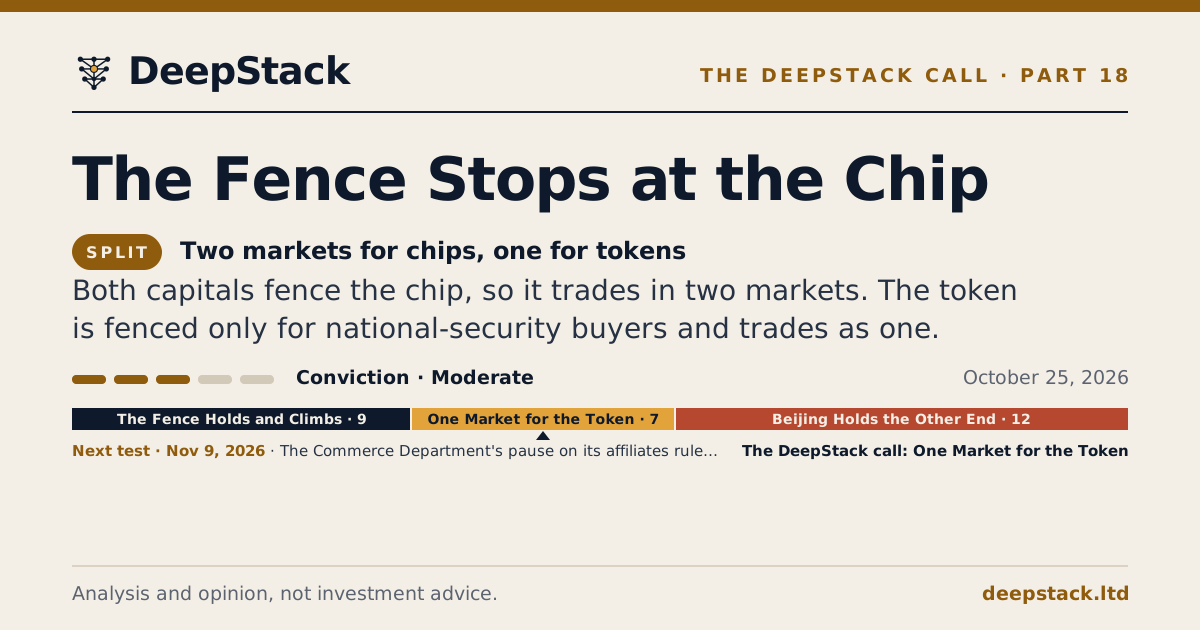
The Fence Stops at the Chip
Washington opened H200 licensing for China in January; Beijing restricted the purchases, and licensed shipments came to less than 1% of Data Center revenue in the quarter to July 26. On the token, Chinese developers drew 47.9% of OpenRouter's text requests in the week of October 5.

Where this Part stands
- The Call
SplitTwo markets for chips, one for tokens.
Both capitals fence the chip, so it trades in two markets. The token is fenced only for national-security buyers and trades as one.
Conviction Moderate · 3 of 5
- The next test
What is established, and what remains uncertain
- What is established
- Nvidia's licensed H200 shipments to China came to less than 1% of Data Center revenue in the quarter to July 26, 2026, after Beijing restricted the purchases (NVIDIA Form 10-Q).
- The Commerce Department's affiliates rule is suspended until November 9, 2026, absent an extension (Federal Register 2025-19846).
- The fiscal 2026 defense act bars DeepSeek's models from the systems of the Pentagon, the intelligence agencies and their contractors (Public Law 119-60, sections 1532 and 6604, December 18, 2025).
- What remains uncertain
- Whether the affiliates-rule pause is extended in writing by November 9 (test p18-t01).
- Whether Beijing lets licensed H200 shipments reach 1% of Nvidia's Data Center revenue (test p18-t02).
- Whether a bar on Chinese models reaches agencies beyond the Pentagon and the intelligence community by March 31, 2027 (test p18-t04).
What is established and what remains uncertain: approved by Marco Cauduro on October 13, 2026.
Explain the mechanism Inspect the evidence Read the countercase See the test
Washington opened its gate on January 15, 2026. That day the Bureau of Industry and Security replaced its presumption of denial with case-by-case review for exports of Nvidia's H200, AMD's MI325X and lesser chips to China and Macau, on three conditions: American customers are not shorted, China-bound volume stays at or below half of what American customers get, and a laboratory in the United States tests every shipment.
Beijing kept its own gate shut. Nvidia's 10-Q for the quarter to July 26, 2026 says the American government granted licenses from February to ship small amounts of H200 to specific China-based customers, and the Chinese government restricted those sales. Nvidia took a $0.4 billion charge on H200 inventory and purchase obligations in the first half of fiscal 2027, and the licensed shipments it did make came to less than 1% of Data Center revenue of $89.0 billion. Each paid a 25% tariff on its way through American inspection, and Beijing, the filing adds, has encouraged buyers to purchase from Nvidia's Chinese competitors. Nvidia's CFO commentary of August 26 put all Hopper shipments to China below 1% of that revenue.
The tokenThe unit a language model is priced by: a fragment of text, roughly three quarters of a word. More → went the other way. In the week beginning October 5, 2026, models from DeepSeek, Z.ai, Alibaba's Qwen, Xiaomi and Tencent drew 47.9% of text requests on OpenRouter, a service that routes developers to hundreds of models, by DeepStack's reading of its rankings on October 12. OpenAI, Google and Anthropic drew 40.3%, and DeepSeek alone, at 24.5%, led every American developer. Requests are not revenue, and OpenRouter's users chase price. The same Nvidia filing says Washington is considering limits on supporting applications built on Chinese open-source models such as DeepSeek, Qwen and Kimi. What is written reaches only the national-security buyers: the defense authorization act for fiscal 2026, signed December 18, 2025, ordered models from DeepSeek and its backer High Flyer off the Pentagon's systems and out of its contractors' defense work, and had the intelligence agencies remove DeepSeek's application from their national security systems and their contractors'.
Part twelve found on October 9 that the token trades as one market. Part eighteen goes down the stack and asks where the fence is written, and by whom. DeepStack read 243 posts, letters, filings and episodes by 83 voices and found 22 disagreements on the question, 5 of them direct contradictions. That is a thin yield for a question this broad, so most of the argument here rests on the rules both capitals have published.
The fence count
DeepStack counted the written measures since January 2025 at each layer of the AI stack as of October 12, 2026, and whether each carries an end date. On silicon, Washington's side is the January 15 rule, with no end date. Beijing's side has no public document; the restriction shows only in Nvidia's 10-Q. The rule that extends American controls to companies at least 50% owned by listed entities was suspended from November 10, 2025, until November 9, 2026. Treasury Secretary Scott Bessent announced on September 23 that the truce with China would run through January 10, 2027, and a Miller Canfield note of October 1 says the suspension is expected to follow. The bureau's Federal Register documents through October 12 carry no extension.
On minerals, China's Announcement No. 70 of November 7, 2025, suspended its October 2025 controls on rare earths, battery materials and superhard materials until November 10, 2026. Press reports after the September summit put that suspension on the same January 10 date; DeepStack found no ministry document carrying it.
On networks and machines, the FCC's Covered List, updated October 9, 2026, bars new authorizations for foreign-made drones and their critical components, added December 22, 2025, for routers made in any foreign country, added March 23, and for foreign-made power inverters and advanced robots, added July 28. Each entry exempts products the Department of War has granted a conditional approval, and the drone, router and inverter entries accept one from Homeland Security as well. Drones on the Defense Contract Management Agency's Blue UAS list, or built as domestic end products under the Buy American standard, stay exempt until January 1, 2028, and toy drones are exempt outright. A rule effective October 13 reaches devices built with logic-bearing parts from listed producers, and it spares equipment already authorized and applications pending that day. The list has named Huawei, ZTE, Hikvision and China's three state carriers since 2021 and 2022; those entries predate this count. Optics have a reported draft and no entry on the October 9 list. On the model, the defense act carries two bars on DeepSeek, one for the Pentagon and its contractors and one for the intelligence agencies and theirs, and lets the Pentagon extend its bar by guidance to models from any AI company based in China.
The count is seven measures without an end date, all American: the January rule, four Covered List entries, the component rule and the defense act. Six sit below the model. The seventh keeps one developer's models off the systems of the Pentagon, the intelligence agencies and their contractors, and reaches no company, cloud or developer outside those buyers. Washington once reached further. On June 12 the Commerce Department imposed a worldwide license requirement on transfers of two Anthropic models to foreign persons, Representative Sam Liccardo wrote on June 18, and a Cloud Security Alliance note records that the requirement was lifted on June 30. Two suspensions, one in each capital, lapse a day apart in November on paper; the truce they belong to runs to January 10 by announcement, and neither capital has published a document extending its suspension.
Where there is hardware to inspect at a border, the fence is written down.
Where there is hardware to inspect at a border, the fence is written down. Where the product is a download, the only fence in federal law surrounds the national-security buyers.
Two gates for silicon
Kevin Gee wrote in A Letter a Day on September 12 that Washington is betting compute is the linchpin of the stack, which makes it the target of export controls, while China builds a domestic stack at every layer. On volume the wager holds. Venkat Somala of Epoch AI estimated on September 4, updated September 24, that Huawei's 2026 chips will be worth 880,000 H100 equivalents against Nvidia's 23 million, under 4% of Nvidia's compute. On Chinese-made memory alone, Epoch puts Huawei near 1.5 million H100 equivalents a year by 2028, against nearly 100 million for Nvidia.
The other side reads the gap as time bought and little more. Doomberg wrote on July 3 that China can invent its way around chip sanctions, citing Huawei's announced framework for 1.4-nanometer-class density by 2031 without extreme ultraviolet lithography. DeepValue Capital wrote on August 24 that Alibaba is ramping its own chip production for a cost advantage.
The written fence also leaks. Isabel Juniewicz of Epoch AI estimated on April 29 that about 660,000 H100 equivalents had been smuggled into China through the end of 2025, within a range of 290,000 to 1.6 million, and put her central figure at roughly a third of China's total compute. The licenses and the restrictions govern the legal market. A gray channel runs beside it, and at the top of Epoch's range it outweighs the legal one.
Gee drew the stakes from Jensen Huang's exchange with Dwarkesh Patel: a DeepSeek model that arrives tuned for Huawei's hardware rather than Nvidia's would cost America ground in the contest for the stack.
DeepStack's reading is that the second chip market is being built from both ends. Washington caps what may cross, Beijing restricts most of what Washington lets through, and Huawei and Alibaba fill the space at a fraction of Nvidia's output. Because both capitals hold the fence, either one can lower its half.
The rack in between
Between chip and model sits the hardware that wires a data center, and there the fence is half drafted. Gaetano warned on August 5 that Chinese suppliers are so large a share of optics that a sudden ban could deepen shortages and push out deployments. Ren answered on August 14 that the FCC's draft ban creates no capacity and hands scarcity pricing to whoever already has supply. Buyers moved first: Gaetano reported on August 11 that customers had grown more insistent on American-made modules.
Gaetano also read the proposal as leverage, calling it on August 5 a negotiating tool ahead of a planned meeting with Xi Jinping, since China controls a substantial share of indium phosphide substrate production and of indium exports. Ren located the grip lower down on August 14: firms outside China hold most of the wafers and the equipment, and Beijing's hold is on the indium and phosphorus beneath them. By October 2 Gaetano was relaying a Morgan Stanley note: a Chinese-built transceiver might still enter if roughly 65% of its value came from American companies, with the 3.2-terabit generation as the point the rule would bite. DeepStack reads a content threshold as a fence with a turnstile, one that sorts a module by where its value is made rather than where it is assembled.
Robots show the finished version. Timothy B. Lee of Understanding AI wrote on August 31 that Washington met Unitree's rise with a House bill naming it and FCC rules on foreign-made robots, and warned that a ban could leave America a robotics backwater while Chinese makers dominate elsewhere. Alice Han and James Kynge, on Prof G Media on September 15, put China's 2025 private AI investment at about one twenty-third of America's, while it shipped ten times as many humanoid robots.
The fence runs both ways. Baillie Gifford's third-quarter 2026 letter calls rare earths leverage Beijing holds over other economies, and Doomberg reported on September 1 that the Pentagon's Office of Strategic Capital is structuring deals to move military supply chains away from China.
One market for the token
Oguz Erkan of Capitalist Letters wrote on July 19 that usage would not drain from American labs to Chinese models: with the cost per unit of intelligence this close, Western firms will avoid Chinese models for strategic and regulatory reasons. The next day Prof G Markets called the Chinese open-weightA model whose trained parameters are published, so anyone can run it without paying the lab. More → strategy, about 80% of a product's value at half the price, one of the most effective business models there is, and expected a geopolitical fight once Washington grasps it. DeepStack reads the two as a direct contradiction about whether Western buyers will take the discount. Three months on, OpenRouter's figures for the week of October 5 lean toward Prof G Markets.
- DeepSeek24.5%
- OpenAI18.6%
- Google17.8%
- Z.ai13.4%
- Qwen (Alibaba)5.4%
- Anthropic3.9%
- Xiaomi2.9%
- Mistral AI2.0%
- Tencent1.7%
- All other authors9.7%
Source: OpenRouter rankings, market share by model author, read Oct 12, 2026; requests, not tokens or dollars
American clouds sell across the line. Market Sentiment noted on September 8 that Azure sells the same DeepSeek V4 Pro weights at $1.90 per million tokens that DeepSeek's own service prices at $0.20, and that on one platform Anthropic's Opus 5 costs about twice DeepSeek, not the twentyfold of headline comparisons. Alice Han and James Kynge, in an August 18 episode, described Microsoft closing offices in China while still selling Azure and AI services to ByteDance and Shein.
Michael Spencer of AI Supremacy wrote on July 21 that China holds the cheaper tokens and the more abundant energy. James Bulltard read the same progress on July 17 as a reason Washington will spend and restrict more, not less.
Erkan may be right about the large Western enterprise, which OpenRouter's developer is not, but his fence is a buyer's choice that no document makes outside the Pentagon and the intelligence agencies. The longer risk is the one Gee names: open weights are China's wedge and carry no lock-in, while the silicon, runtime and on-site engineers beneath them are bought from whoever builds the stack, and Huawei sends engineers.
Gee holds that China is the world's supplier and not yet its platform. A day later Stephen Clapham of Behind the Balance Sheet relayed the opposite view from Sir Michael Moritz, the former Sequoia investor, whose conversation at a Financial Times event he had watched: the technological baton is passing to China, as it once passed from Britain to America, on the strength of electric vehicles, batteries and solar. DeepStack reads the two as a direct contradiction. On AI the record favors Gee for now: China's models travel as open weights, and the licensed chips under them stay home.
DeepStack's reading is that one token market is how two stacks could form later. Today a Chinese model runs on an American cloud and an American chip. If the next DeepSeek arrives tuned for Huawei, the token market stays whole only while the weights run on both.
What settles it
Four public documents test the reading by March 31, 2027, each asked before its date.
On November 9, the affiliates-rule pause ends on paper unless a Federal Register document extends it. The truce announced on September 23 runs to January 10, and Miller Canfield expects the suspension to follow, but Washington has not confirmed that it does. Last year's suspension reached public inspection only on November 10, 2025, the day it began, and a document that lands a day late again is a no. China's rare-earth suspension lapses on paper the next day, and the commerce ministry's site is where its extension would appear. The Asia-Pacific leaders' meeting in Shenzhen later in November, the next chance to write the truce down, comes after both lapses.
On November 18, Nvidia reports its quarter to October 25, 2026. The line that matters sits in the 10-Q: whether licensed H200 shipments to China-based customers reach 1% of Data Center revenue, after less than 1% in the quarter to July 26. Below that line, Beijing's gate is still shut.
By December 31, the FCC's Covered List either carries an entry for optical transceivers or it does not. The October 13 component rule does not count. By March 31, 2027, a law or a Federal Register rule either bars Chinese-developed models from federal agencies beyond the Pentagon and the intelligence community or leaves the token market as it stands.
What would prove DeepStack wrong is Nvidia shipping licensed H200 at 1% or more of Data Center revenue, a written bar on Chinese models that reaches past the national-security buyers, or Chinese developers' share of OpenRouter requests falling below 25% with no rule behind it, which would prove Erkan right about the buyer's choice. The chip half describes the licensed market, and smuggled chips run beside it uncounted.
Run the numbers
The figures in this story, built into a chart you can test for yourself.
Data Desk · Part 18Markets
Who answers the requests
Share of text requests on one router by model author in the week of October 5, with the five Chinese developers grouped, and three different counts of China's share. Sort by share or by country.
As of Oct 11, 2026 · weekly, read by hand · published Oct 12, 2026 · read Oct 12, 2026 · observed · next release the next weekly reading
Share of text requests on OpenRouter, week beginning October 5, 2026
- DeepSeek24.5%
- OpenAI18.6%
- Google17.8%
- Z.ai13.4%
- All other authors9.7%
- Qwen (Alibaba)5.4%
- Anthropic3.9%
- Xiaomi2.9%
- Mistral AI2.0%
- Tencent1.7%
DeepSeek answered 24.5% of requests, OpenAI 18.6%, Google 17.8%. The five Chinese developers together: 47.9%.
The DeepStack call
SplitTwo markets for chips, one for tokens
Both capitals fence the chip, so it trades in two markets. The token is fenced only for national-security buyers and trades as one.
What to do with this
- Read the H200 line in Nvidia's 10-Q after the Nov 18 results: under 1% of Data Center revenue means Beijing's gate is still shut.
- Check the Federal Register on Nov 9 and China's commerce ministry on Nov 10, not the communique: without a document, each pause lapses.
- Price a Chinese model on one cloud before trusting a tenfold gap: DeepSeek V4 Pro cost $0.20 per million tokens direct, $1.90 on Azure.
What would change our mind
- Nvidia's 10-Q for the quarter to Oct 25 puts licensed H200 shipments to China at 1% or more of Data Center revenue.
- A law or rule bars Chinese-developed AI models from agencies beyond the Pentagon and the intelligence community by Mar 31, 2027.
- Chinese developers' share of OpenRouter text requests falls below 25% in the week of Jan 4, 2027, with no rule behind it.
Next test
All 4 testsRead the full argument
The DeepStack Call is that the US and China are building two markets for chips and one for tokens. Both capitals hold the chip fence: Washington licenses the H200 under a rule with no end date, Beijing restricts the purchases without a public document, and Nvidia shipped less than 1% of its $89.0 billion of Data Center revenue under the licenses in the quarter to July 26, 2026. At the model, the written bars keep DeepSeek off the systems of the Pentagon, the intelligence agencies and their contractors, and Chinese developers drew 47.9% of OpenRouter's text requests in the week of October 5. The single most important reason for caution is that the token half rests on usage among price-sensitive developers, which can change without a rule, and that is why conviction stops at three. The chip half describes the licensed market; Epoch AI puts smuggled chips at roughly a third of China's compute. The view changes if Nvidia's November 10-Q puts licensed H200 shipments to China at 1% or more of Data Center revenue, or if a law or rule bars Chinese models from agencies beyond the Pentagon and the intelligence community by March 31, 2027. The first answer arrives on November 9, in the Federal Register.
Call history
- v2Two markets for chips, one for tokensConviction Moderate (3/5)Side: One Market for the TokenSide named by the owner.
- v1Two markets for chips, one for tokensConviction Moderate (3/5)First call, with the story.
The numbers behind the Call<1%47.9%Nov 9, 2026
Analysis and opinion, not investment advice.
What to watch
The Commerce Department's pause on its affiliates rule ends on paper: whether a Federal Register document extends it by that day. The truce announced on September 23 is not such a document. Pre-specified
- Question
- By November 9, 2026, does the Bureau of Industry and Security publish in the Federal Register, or place on public inspection there, a document extending the suspension of its affiliates rule beyond November 9, 2026?
- Source
- Federal Register, documents and public inspection of the Bureau of Industry and Security
- Rule
- Read the bureau's documents and the public inspection entries on federalregister.gov through November 9, 2026. The answer is yes if a document of the Bureau of Industry and Security that extends the one-year suspension published as Federal Register 2025-19846 beyond November 9, 2026, or leaves it in force without an end date, was published or placed on public inspection by the end of November 9, 2026; no if none was, including when officials announce an extension that no document carries by that day.
- If the source is late, revised or silent
- If federalregister.gov cannot be read on November 10, 2026, the same pages are read on November 12, since public inspection entries carry their filing time. If no reading is possible by November 13, 2026, the test is inconclusive, and the Result says what was read and what was missing; the next reading is November 16, 2026. A document placed on public inspection by November 9 and published afterward counts as yes.
- Base rate
- Last year's suspension reached public inspection only on November 10, 2025, the day it took effect, and no bureau document carried an extension through October 12, 2026.
- Outside view
- Both suspensions in this Part lapse on paper a day apart in November, and the truce they belong to runs to January 10 by announcement, with no document from either capital extending them.
- What would change the number
- A bureau document placed on public inspection by November 9, which Miller Canfield expects to follow the announced truce, would raise the number.
The Call, before the dateExpects no. Gives the yes answer 40%.
0 · no100 · yes
Your numberSign in by email to forecast
Nvidia reports its quarter to October 25, 2026: whether its 10-Q puts licensed H200 shipments to China at 1% or more of Data Center revenue, after less than 1% in the quarter to July 26. Pre-specified
- Question
- Does Nvidia's Form 10-Q for the quarter ending October 25, 2026 put shipments of licensed H200 products to China-based customers at 1% or more of that quarter's Data Center revenue?
- Source
- SEC EDGAR, NVIDIA Form 10-Q for the third quarter of fiscal 2027, discussion of export controls and China (CIK 1045810)
- Rule
- Read the 10-Q's discussion of export controls and of the H200 licenses for China. The answer is yes if it states a share of 1% or more, or a dollar amount equal to or above 1% of the quarter's Data Center revenue, for shipments of H200, or of another product licensed under the rule of January 15, 2026, to customers in China; no if it states less than 1%, says there were no such shipments, or gives no figure for them. In the quarter ended July 26, 2026 the same section said less than 1% of Data Center revenue of $89.0 billion.
- If the source is late, revised or silent
- If the 10-Q is not public on SEC EDGAR by December 15, 2026, the test is inconclusive, and the Result says what was read and what was missing; the next reading is January 5, 2027. A share given only for all shipments to China, or for all Hopper products, does not decide the test and enters the Result as evidence.
- Base rate
- In the quarter to July 26, 2026, licensed H200 shipments to China came to less than 1% of Nvidia's $89.0 billion of Data Center revenue, after a $0.4 billion charge on H200 inventory.
- Outside view
- Two gates decide this line, Washington's licenses and Beijing's restriction on the purchases, and Beijing has encouraged buyers toward Nvidia's Chinese competitors instead.
- What would change the number
- A public sign that Beijing is letting its buyers take the licensed H200 before the quarter ends on October 25 would raise the number.
The Call, before the dateExpects no. Gives the yes answer 15%.
0 · no100 · yes
Your numberSign in by email to forecast
Whether the FCC's Covered List carries an entry for optical transceivers or modules, after its October 9, 2026 update left them off. Pre-specified
- Question
- By December 31, 2026, does the FCC's Covered List carry an entry for optical transceivers or optical modules, named by producer or by country of production?
- Source
- Federal Communications Commission, Covered List
- Rule
- Read the Covered List page and the FCC public notices that update it through December 31, 2026. The answer is yes if an entry added by that day names optical transceivers or optical modules, by producer or by country of production; no if no such entry was added. The component rule effective October 13, 2026, which reaches logic-bearing parts from producers already listed, does not count, nor does a proposal that adds no entry. The list as updated October 9, 2026 carried no such entry.
- If the source is late, revised or silent
- If the Covered List page cannot be read on January 4, 2027, the FCC's public notices on docs.fcc.gov dated through December 31, 2026 are read instead. If neither can be read by January 8, 2027, the test is inconclusive, and the Result says what was read and what was missing; the next reading is January 11, 2027.
- Base rate
- The FCC added drones in December 2025, routers in March and inverters and robots in July, but the list as updated October 9, 2026 carried no entry for optics.
- Outside view
- Optics have only a reported draft, and the framework relayed on October 2 would let a Chinese-built module in with about 65% American value and bite only at the 3.2-terabit generation.
- What would change the number
- A vote or public notice that turns the reported optics draft into a Covered List entry before December 31 would raise the number.
The Call, before the dateExpects no. Gives the yes answer 35%.
0 · no100 · yes
Your numberSign in by email to forecast
Whether a law or a Federal Register rule bars agencies beyond the Pentagon and the intelligence community from Chinese-developed AI models; the defense act of December 2025 reaches only those buyers and their contractors. Pre-specified
- Question
- By March 31, 2027, does a public law, or a rule or executive order published in the Federal Register, bar federal agencies beyond the Department of Defense and the intelligence community from acquiring or using AI models developed by companies based in China?
- Source
- GovInfo, public laws of the 119th Congress, read with the Federal Register
- Rule
- Read the public laws listed on GovInfo and the rules and executive orders published in the Federal Register through March 31, 2027. The answer is yes if one of them, signed or published by that day, bars executive agencies other than the Department of Defense and the intelligence community, or their contractors, from acquiring or using AI models developed by DeepSeek or by other companies based in China, whatever its effective date; no if none does. Rules that implement section 1532 of Public Law 119-60 for defense contracts do not count, nor do bills passed by one chamber, agency memoranda or bans limited to an app on government devices.
- If the source is late, revised or silent
- If govinfo.gov or federalregister.gov cannot be read on April 1, 2027, the test is read on April 5 from congress.gov's list of public laws and the Federal Register's public inspection pages. If no reading is possible by April 9, 2027, the test is inconclusive, and the Result says what was read and what was missing; the next reading is April 12, 2027. A law signed by March 31 and listed later is read from its signing date.
- Base rate
- The only written bars on Chinese models in federal law, sections 1532 and 6604 of the fiscal 2026 defense act, reach the Pentagon, the intelligence agencies and their contractors.
- Outside view
- A bill for every agency was introduced in 2025 and, as far as DeepStack read, not enacted, so the fiscal 2027 defense act is the likeliest carrier of a wider bar.
- What would change the number
- A fiscal 2027 defense act signed by March 31 with a bar for all agencies, or a rule on the limits Washington is considering for Chinese models, would raise the number.
The Call, before the dateExpects no. Gives the yes answer 30%.
0 · no100 · yes
Your numberSign in by email to forecast
Follow
Follow Part 18: one email when one of its tests resolves.
Sources and further reading (23)
- Bureau of Industry and Security - License review policy for advanced computing, Federal Register, Jan 15, 2026
- NVIDIA - Form 10-Q for the quarter ended July 26, 2026
- NVIDIA - CFO commentary, second quarter of fiscal 2027, Aug 26, 2026
- OpenRouter - LLM rankings, market share by model author, read Oct 12, 2026
- GovInfo - National Defense Authorization Act for Fiscal Year 2026, Public Law 119-60, sections 1532 and 6604, Dec 18, 2025
- Bureau of Industry and Security - One-year suspension of the affiliates rule, Federal Register, Nov 12, 2025
- JD Supra - Miller Canfield, BIS affiliates rule suspension extended but uncertainty remains, Oct 1, 2026
- China Ministry of Commerce - Announcement No. 70 of 2025, Nov 7, 2025
- Federal Communications Commission - Covered List, updated Oct 9, 2026
- Federal Communications Commission - Equipment authorization rule, Federal Register, Sep 11, 2026
- Rep. Sam Liccardo - Letter to the Commerce Department on frontier model export controls, Jun 18, 2026
- Epoch AI - Will Huawei catch up to Nvidia by 2030?, Sep 4, 2026
- Epoch AI - Isabel Juniewicz, Diversion and resale: estimating compute smuggling to China, Apr 29, 2026
- Understanding AI - Timothy B. Lee on Unitree, Aug 31, 2026
- Prof G Media - Alice Han and James Kynge on China, Sep 15, 2026
- Baillie Gifford - Q3 2026 letter
- Capitalist Letters - Oguz Erkan, Jul 19, 2026
- Prof G Markets - Jul 20, 2026
- Market Sentiment - Notes on Open Source, Sep 8, 2026
- Prof G Media - Alice Han and James Kynge on Microsoft in China, Aug 18, 2026
- AI Supremacy - Michael Spencer, Jul 21, 2026
- James Bulltard - Jul 17, 2026 recap
- DeepStack - Part twelve, The Model Is Not the Price
Market data are as of the dates cited.